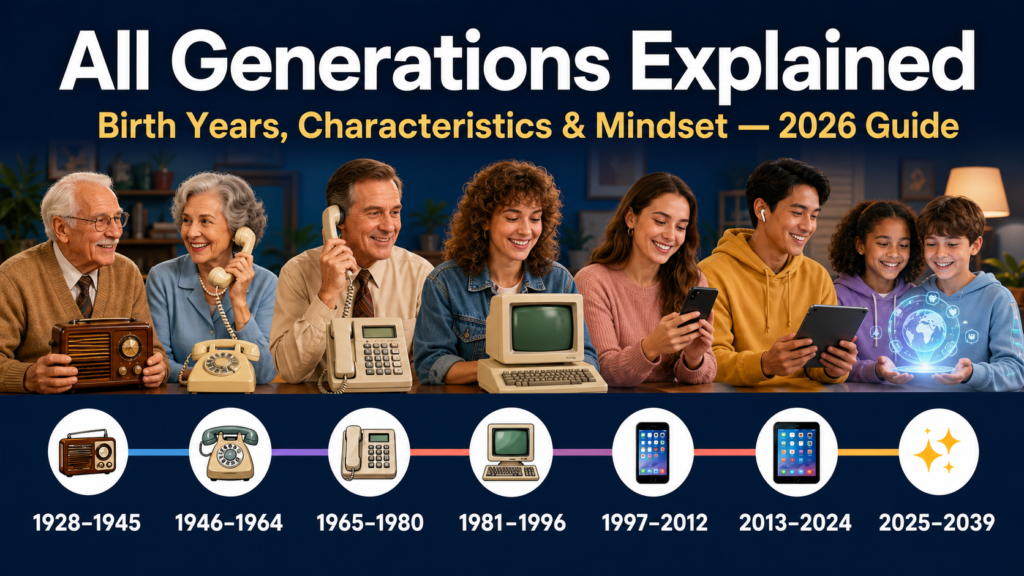
Why does one colleague want a quick call, another wants a detailed email, and a third sends a voice note with three emojis and says, “Got it”? Why do parents sometimes interpret a Gen Z child’s need for privacy as disrespect—or why might a young employee see a manager’s request for office time as a lack of trust?
Often, it is not about one generation being “better” or “worse.” It is about people growing up in different economic realities, family structures, technologies, and cultural moments. The result: different assumptions about work, success, communication, security, and what a good life looks like.
All generations explained in a practical, stereotype-free way—from the Silent Generation to Gen Beta. Whether you are an Indian parent trying to understand your Gen Z or Gen Alpha child, a manager leading a mixed-age team, an HR professional building stronger culture, or simply curious about your own mindset, this is your 2026 reference guide.
Before We Start: Generations Are Patterns, Not Personality Tests
Generational labels are useful shortcuts, not destiny.
A Gen Z student in Mumbai, Dubai, Lagos, London, or New York will not have the same life experience. A Millennial entrepreneur may share more in common with a Gen Z creator than with a peer in another industry. A Baby Boomer grandparent who uses video calls every day may be more digitally confident than a younger relative.
Use these categories to become more curious—not to make assumptions.
The practical rule: Start with the generation for context. Then get to know the person in front of you.
The concept of a generation typically refers to people born across roughly a 15–20-year span, whose formative experiences may shape broad social patterns. It is not a scientific diagnosis or a replacement for individual understanding.
1. Silent Generation: Duty, Stability and Quiet Strength – All Generations Explained
Birth Years and Age in 2026
- Born: 1928–1945
- Age in 2026: 81–98
- Also known as: Traditionalists in some workplace material
Formative Events
Many Silent Generation members were children during the Great Depression or World War II and lived through post-war rebuilding, rationing, rapid industrial development, and major social change. Their early technology environment included radio, newspapers, landline phones, cinema, and later television.
Core Mindset
For many people in this cohort, security was not assumed—it was built patiently. Work often represented duty, dignity, and a route to stability for the family.
The unspoken social contract often sounded like this:
“Work hard, be dependable, respect institutions, and create a safer life for the next generation.”
Key Values
- Responsibility and reliability
- Respect for commitments
- Financial caution
- Family duty
- Community and service
Communication Style
- Often value face-to-face conversation, telephone calls, and written letters or formal messages
- May appreciate clear, respectful language over rapid-fire digital messages
- Can find unexplained jargon, rushed communication, or constant device use frustrating
Work Style
Many are retired, though some remain active as advisers, business owners, volunteers, community leaders, and mentors. They often lead through experience, consistency, and institutional knowledge.
Misconceptions to Avoid
- “They cannot use technology.” Many actively use video calls, messaging, online banking, and social platforms.
- “They resist all change.” Many have lived through enormous change.
- “They are out of touch.” Their long-term perspective can be highly valuable.
How to Connect
- Ask for stories, not just advice: “What was your first job like?”
- Avoid rushing important conversations.
- Show how new technology solves a real problem rather than assuming it is self-explanatory.
2. Baby Boomers: Achievement, Growth and Institution Building
Birth Years and Age in 2026
- Born: 1946–1964
- Age in 2026: 62–80
The Baby Boom generation is the only cohort formally tied to a documented post-war surge in births in the United States, although the label has become globally familiar.
Formative Events
Boomers experienced post-war economic expansion, television’s rise, the space race, civil-rights movements, Cold War politics, and large-scale social transformation. Many entered adulthood during periods when long-term employment, home ownership, and upward mobility appeared more attainable for a larger share of families than today.
Core Mindset
Many Boomers grew up with a belief in advancement through effort, experience, credentials, and loyalty. That does not mean every Boomer had the same opportunity—but it explains why career progression, job titles, and visible achievement often carry meaning.
Their social contract often sounded like:
“Commit, work hard, prove yourself, and opportunity will follow.”
Key Values
- Achievement and professional credibility
- Progress through effort
- Financial security
- Loyalty and responsibility
- Building a legacy for family or community
Communication Style
- Often comfortable with calls, meetings, and email
- May prefer direct conversation for significant decisions
- Can be frustrated by vague messages, delayed responses, or communicating only through informal chat channels
Work Style
Boomers may value visible commitment, experience, and structured career progression. Many became leaders during periods when “paying dues” and staying with one employer for years were common career paths.
What often motivates them: Recognition, influence, responsibility, expertise, and meaningful contribution.
Misconceptions to Avoid
- “All Boomers oppose flexibility.” Many value flexibility, especially as caregivers or later-career professionals.
- “They only care about hierarchy.” Plenty prefer collaborative leadership.
- “They do not understand mental health.” Awareness and openness vary widely by person, culture, and experience.
How to Connect
- Be direct about your goals and expectations.
- Respect experience without treating it as the only source of insight.
- When proposing change, explain the business reason, benefits, and implementation plan.
3. Generation X: Independence, Adaptability and Healthy Skepticism
Birth Years and Age in 2026
- Born: 1965–1980
- Age in 2026: 46–61
Formative Events
Gen X grew up through economic uncertainty in many countries, changing family structures, the end of the Cold War, globalization, and the shift from analogue to digital life. They remember pre-internet childhoods and adapted to computers, mobile phones, email, and the web as teens or adults.
Core Mindset
Gen X often learned self-reliance early. Many value competence over performance, freedom over micromanagement, and practical outcomes over buzzwords.
Their informal contract with employers may sound like:
“Give me room to do good work, respect my time, and judge me on results.”
Key Values
- Independence
- Efficiency
- Work-life boundaries
- Practicality
- Personal responsibility
Communication Style
- Usually flexible: comfortable with email, calls, text, and meetings
- Often prefer concise, purposeful communication
- May dislike unnecessary meetings, overly formal corporate language, or constant checking-in
Work Style
Gen X often operates as the bridge between older and younger colleagues. Many are senior managers, parents of Gen Z or Gen Alpha children, and decision-makers navigating both traditional and digital work expectations.
What motivates them: Autonomy, trust, efficient systems, fair recognition, and time for life outside work.
Misconceptions to Avoid
- “Gen X is cynical.” Often they are simply practical and evidence-driven.
- “They do not care about purpose.” Many care deeply, but may want action rather than slogans.
- “They hate feedback.” They often prefer honest, specific feedback over vague praise.
How to Connect
- Give ownership, then avoid unnecessary micromanagement.
- Make meetings shorter and decisions clearer.
- Show respect for their time and expertise.
4. Millennials: Meaning, Flexibility and Reinvention
Birth Years and Age in 2026
- Born: 1981–1996
- Age in 2026: 30–45
- Also known as: Generation Y
Pew Research uses 1981–1996 for Millennials, making 1996 the final Millennial birth year and 1997 the beginning of Gen Z.
Formative Events
Millennials grew up alongside the internet, mobile phones, social media, globalization, the 9/11 era, the 2008 global financial crisis, changing career markets, and the rise of the gig economy. Older Millennials may remember dial-up internet and CDs; younger Millennials may have entered adulthood during smartphones and social platforms.
Core Mindset
Many Millennials were told education and hard work would create opportunity, then entered adult life amid rising costs, unstable employment, and economic disruption. As a result, they often value flexibility, purpose, learning, and financial resilience.
Their social contract may sound like:
“I will work hard, but I need growth, fairness, flexibility, and a life beyond my job.”
Key Values
- Meaningful work
- Continuous learning
- Flexibility
- Financial stability
- Inclusion and collaboration
Communication Style
- Comfortable with email, chat, text, video calls, and collaborative tools
- Often value feedback and transparency
- May be frustrated by unclear career paths, slow decision-making, or “because we have always done it this way”
Work Style
Millennials have become a major force in leadership, management, entrepreneurship, and parenting. In the U.S. workforce, Millennials were estimated at 35% in 2025, the largest generational share in one workforce projection.
What motivates them: Development, meaningful impact, fair pay, flexibility, recognition, and opportunities to lead.
Misconceptions to Avoid
- “Millennials are entitled.” Often they are responding to a different economic reality.
- “They only want perks.” Many prioritize flexibility because of caregiving, cost pressures, and wellbeing.
- “They hate commitment.” Many commit strongly when there is trust, growth, and fairness.
How to Connect
- Explain the “why” behind decisions.
- Offer clear development pathways.
- Measure performance by outcomes, not only visible desk time.
5. Generation Z: Authenticity, Agency and Mental Wellbeing
Birth Years and Age in 2026
- Born: 1997–2012
- Age in 2026: 14–29
Formative Events
Gen Z grew up with smartphones, social media, streaming, influencer culture, on-demand information, online learning, climate anxiety, geopolitical uncertainty, the COVID-19 pandemic, and the rapid arrival of generative AI.
They are often described as digital natives, but that phrase needs nuance. Being fluent with apps does not automatically mean they have strong digital literacy, privacy awareness, or healthy online habits. These skills still need teaching.
Core Mindset
Many Gen Z young people seek a combination of security and self-expression. They have seen how quickly jobs, economies, and online reputations can change. As a result, many care about practical skills, mental wellbeing, financial independence, identity, and work that aligns with their values.
Their social contract may sound like:
“Treat me fairly, communicate honestly, help me grow, and do not expect work to consume my entire identity.”
Key Values
- Authenticity
- Mental wellbeing
- Flexibility and autonomy
- Inclusion and fairness
- Financial independence and practical skills
Communication Style
- Comfortable with texting, short videos, voice notes, DMs, group chats, and visual communication
- Often expect quick acknowledgment, even if a full answer comes later
- May find overly formal messages, unexplained hierarchy, and vague feedback frustrating
Work Style
Gen Z often values learning, mentorship, flexibility, and clear outcomes. They may question traditional work rules—not always because they lack work ethic, but because they want to understand purpose and fairness.
A 2025 U.S. workforce projection estimated Gen Z at 20% of the workforce, with its share continuing to grow.
Misconceptions to Avoid
- “Gen Z does not want to work.” Many want stability, growth, and work worth doing.
- “They are too sensitive.” Open discussion of mental health can be a strength, not a weakness.
- “They only communicate online.” Many value in-person connection when it feels genuine and inclusive.
How to Connect
- Give feedback early, specifically, and respectfully.
- Explain the purpose behind tasks and rules.
- Offer mentoring, skills development, and clear growth opportunities.
- For parents: replace interrogation with curiosity—ask, “What was the most interesting part of your day?” instead of only, “How were your marks?”
6. Generation Alpha: Curiosity, Customization and AI-Native Childhoods
Birth Years and Age in 2026
- Born: 2013–2024
- Age in 2026: 2–13
McCrindle’s framework defines Gen Alpha as those born from 2010–2024, while other recent guides use 2013–2024. Because these categories are still evolving, the exact boundary differs by source. This article uses 2013–2024 to follow directly after the 1997–2012 Gen Z range used above.
Formative Events
Gen Alpha is growing up with streaming platforms, touchscreens, voice assistants, hybrid learning, smart devices, climate conversations, and AI tools entering homes and classrooms.
For many Indian and global families, they are also growing up in multi-device homes where grandparents use WhatsApp video calls, parents work online, and school learning may blend physical classrooms with digital platforms.
Core Mindset
It is too early to make firm claims about a whole generation of children. But their environment suggests they may expect personalization, instant access, visual learning, and interactive experiences.
Key Values Emerging
- Exploration and creativity
- Visual and interactive learning
- Inclusion
- Personalization
- Safety and belonging
Communication Style
- Often respond well to visual, short, interactive, and hands-on communication
- May learn through video, games, demonstrations, and conversation
- Can be frustrated by long passive instruction without interaction
Education and Future Work Style
Most Gen Alpha members are still in childhood, so “work style” claims should be treated as speculation. The practical focus today is helping them develop foundational skills: attention, empathy, reading, numeracy, critical thinking, communication, creativity, and safe digital judgment.
Misconceptions to Avoid
- “They are addicted to screens by nature.” Children need adult-designed routines and environments.
- “They know technology, so they know how to use it safely.” Digital fluency and digital wisdom are different.
- “AI will do everything for them.” They still need foundational human skills.
How to Connect
- Make learning active: “Show me,” “Build it,” “Try it,” “Explain it back.”
- Set consistent, age-appropriate digital boundaries.
- Talk about online safety as an ongoing conversation, not a one-time lecture.
7. Generation Beta: The Beginning of an AI-Integrated Generation
Birth Years and Age in 2026
- Born: 2025–2039
- Age in 2026: 0–1
Generation Beta is a recently named cohort. McCrindle defines Gen Beta as children born from 2025 to 2039.
Formative Events
It is far too early to describe Gen Beta’s personality or workplace preferences. What we can say is that they are being born into a world shaped by generative AI, automation, climate adaptation, connected devices, changing family structures, and rapid advances in health and education technology.
Core Mindset
Unknown—and that is okay.
Every headline claiming to know exactly what Gen Beta will be like should be read with caution. Their real identity will be shaped by parents, schools, culture, policy, economics, technology, and events that have not happened yet.
What Parents and Educators Can Focus On Now
- Secure relationships
- Play and language development
- Curiosity
- Healthy routines
- Safety around technology
- Human connection alongside digital convenience
Misconceptions to Avoid
- “They will be robots because they are born around AI.” Children still learn through attachment, play, movement, and human interaction.
- “Technology will replace parenting or teaching.” It cannot replace trust, values, and relationships.
- “We already know their future.” We do not.
How to Connect
For Gen Beta, the simplest advice is the most important: talk, read, play, listen, and create safe routines. Their future will need technology skills—but also empathy, resilience, ethical judgment, and human connection.
Read more: Gen Z Happiness: 7 Signs Your Child Is Thriving (Not Just Surviving)
Generational Differences at a Glance
How Each Generation May Define Hard Work
| Generation | A common view of hard work |
|---|---|
| Silent Generation | Duty, persistence, reliability, doing what needs to be done |
| Baby Boomers | Effort, commitment, visible contribution, career advancement |
| Gen X | Competence, efficiency, independence, delivering results |
| Millennials | Impact, learning, collaboration, balancing work with life |
| Gen Z | Purposeful outcomes, skill growth, fairness, healthy boundaries |
| Gen Alpha | Still forming; likely to value interactive learning and creativity |
| Gen Beta | Too early to define |
What “Making It” Can Mean
| Generation | Common success markers |
|---|---|
| Silent Generation | Stability, family security, respect, service |
| Baby Boomers | Achievement, career progression, assets, legacy |
| Gen X | Independence, security, work-life control |
| Millennials | Meaning, flexibility, financial resilience, experiences |
| Gen Z | Authenticity, wellbeing, skills, independence, positive impact |
| Gen Alpha | Emerging; likely to include creativity, belonging, adaptability |
| Gen Beta | Unknown |
Communication Preferences
| Generation | Often comfortable with | Can find frustrating |
|---|---|---|
| Silent Generation | Face-to-face, phone, clear written messages | Rushed digital communication, unexplained jargon |
| Baby Boomers | Phone, email, meetings | Vague updates, communication only through chat |
| Gen X | Concise email, calls, texts | Unnecessary meetings, micromanagement |
| Millennials | Chat, email, collaborative apps, video | Lack of feedback or transparency |
| Gen Z | Text, DMs, voice notes, video, visual communication | Formality without warmth, unclear expectations |
| Gen Alpha | Visual, interactive, voice-enabled tools | Passive, one-way instruction |
| Gen Beta | Too early to define | Too early to define |
Common Generational Conflicts—and Better Solutions
Workplace Scenario: “Why Do You Need to Work From Home?”
The tension:
A Boomer or Gen X manager sees regular office presence as teamwork, visibility, and commitment. A Gen Z employee sees flexibility as a way to focus, manage wellbeing, reduce commuting time, and work efficiently.
What both sides may be missing:
The manager may be worried about collaboration and culture. The employee may be worried about trust and autonomy.
Better solution:
Agree on outcomes, not assumptions.
- Define which tasks require in-person collaboration.
- Set clear response times and meeting expectations.
- Measure performance through deliverables, not desk visibility.
- Review what is working after 30–60 days.
Family Scenario: “You Are Always on Your Phone”
The tension:
A parent may see screen time as isolation. A Gen Z teen may see the phone as friendship, study support, entertainment, creativity, and community.
Better solution:
Talk about how the phone is being used rather than making it a moral battle.
Try:
“What are you watching or talking about?”
“Does being online make you feel connected, stressed, or both?”
“Let’s agree on phone-free moments that work for everyone.”
Workplace Scenario: “Why Do You Need So Much Feedback?”
The tension:
A senior leader may believe no news means good news. A younger employee may interpret silence as confusion or lack of support.
Better solution:
Use brief, predictable check-ins.
- One 15-minute weekly check-in
- One clear priority list
- Specific feedback: what worked, what to improve, and what success looks like next time
Family Scenario: “Why Won’t You Tell Me Anything?”
The tension:
Parents may ask questions because they care. Teens may withdraw because questions feel like an interview.
Better solution:
Create everyday connection before a crisis.
- Chat during a drive or while cooking.
- Share your own story first.
- Ask one open question, then give them room.
- Let silence exist without immediately filling it.
Read more: Best AI Study Prompts for Science, Maths and Coding
Frequently Asked Questions
Which generation am I?
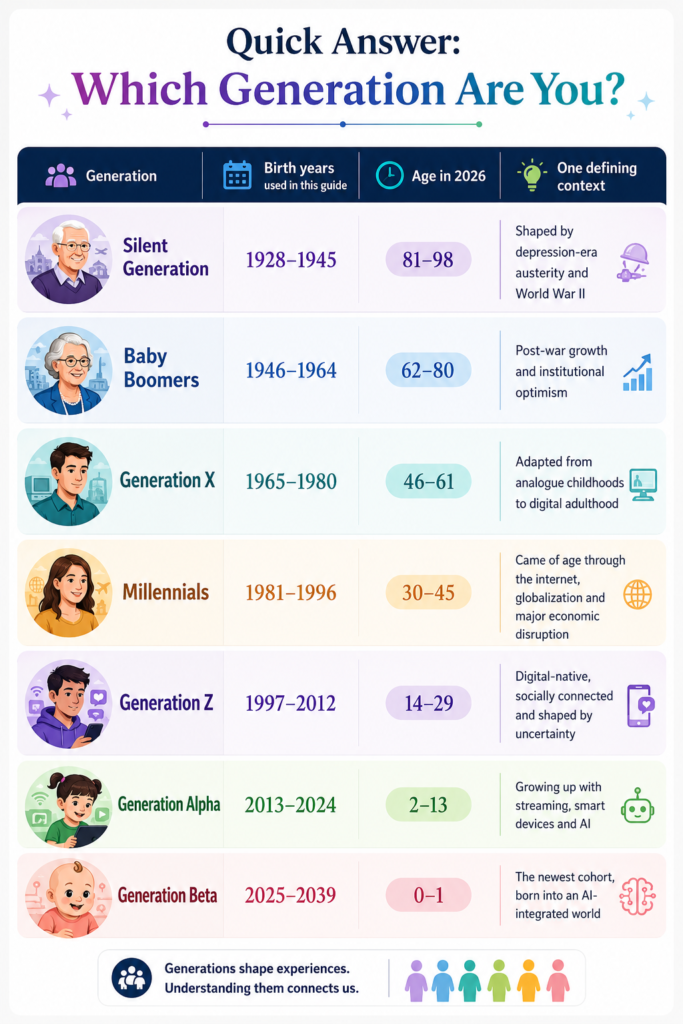
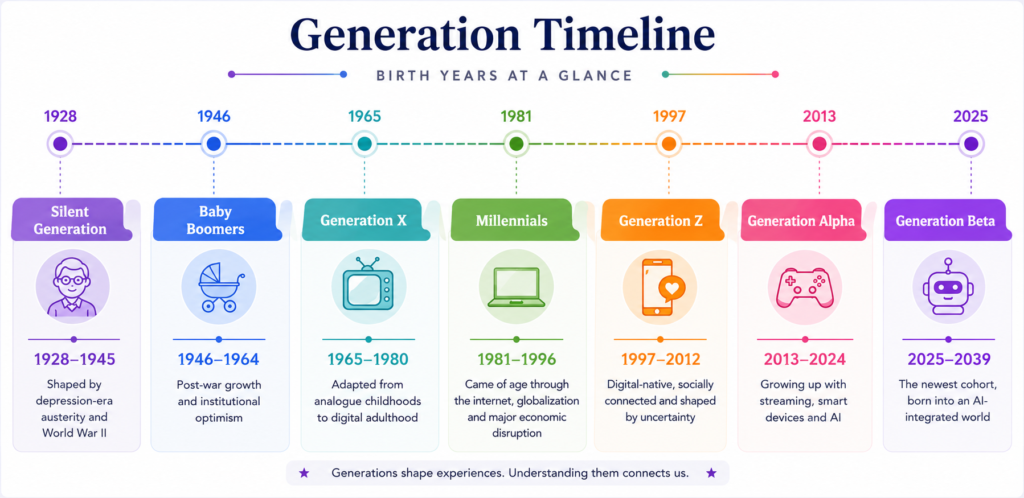
Use this quick guide:
1928–1945: Silent Generation
1946–1964: Baby Boomer
1965–1980: Generation X
1981–1996: Millennial
1997–2012: Generation Z
2013–2024: Generation Alpha
2025–2039: Generation Beta
Remember that different researchers use slightly different cut-offs, especially for Gen Alpha and Gen Beta.
Why is Gen Z so different from Millennials?
Gen Z grew up with smartphones, social media, always-on information, the pandemic, and AI arriving much earlier in life. Millennials remember a more gradual move from offline to online life. These different formative experiences can shape communication habits, expectations around work, views on mental health, and comfort with rapid change.
But overlap is real. Both generations often value flexibility, transparency, learning, and purpose.
Is Gen Alpha just Gen Z with more technology?
No. Gen Alpha is growing up in a different environment, with AI tools, streaming, smart devices, and highly personalized digital experiences present from early childhood. Still, it is too early to make fixed claims about their character. Parenting, education, culture, economics, and community will matter as much as technology.
Do these generational labels really matter?
They matter when they help you ask better questions and design better environments. They do not matter when they become excuses to stereotype, dismiss, or avoid listening.
Use generational understanding as a map—not a label.
What about micro-generations such as Xennials and Zillennials?
Micro-generations describe people born near the edge of major cohorts.
Xennials: Often people born around the late 1970s to early 1980s; they may remember an analogue childhood and digital adulthood.
Zillennials: Often people born around the mid-to-late 1990s to early 2000s; they may identify with both Millennial and Gen Z experiences.1
These labels can be useful when someone feels “between” two larger generations, but the exact years vary widely.
The Bottom Line: Curiosity Beats Stereotypes
Understanding generations is not about deciding who has the best work ethic, who is “too sensitive,” who uses too much technology, or who had it hardest.
It is about recognizing that people are shaped by the times they live through.
A Baby Boomer parent may value security because they were raised to build it. A Gen X manager may value independence because they learned to adapt. A Millennial may seek flexibility because they experienced economic disruption. A Gen Z student may ask for mental-health support because they have language for emotions that earlier generations were not always encouraged to use. A Gen Alpha child may learn differently because the world around them is fundamentally more interactive.
The best families, classrooms, and workplaces do not force everyone to communicate, learn, and work in the same way. They build bridges.
So ask a question. Listen to the answer. Share what shaped you. And remember: the generation gap gets smaller the moment people feel respected.
Which generation are you—and what is one thing people often misunderstand about it? Share your experience in the comments.
- Gen Z vs Gen Alpha: 12 Key Differences Explained
- Who Is Gen Z? Characteristics, Mindset, Behaviour & Expectations (2026 Guide)
- 16 Gen Z Slang Words You Haven’t Heard Yet: Meanings, Examples & Context (2026)
- 10 Gen Z Phrases Every Parent Should Know in 2026 (With Examples)
- Gen Z Happiness: 7 Signs Your Child Is Thriving (Not Just Surviving)
Pingback: Gen Z Happiness: 7 Signs Your Child Is Thriving (2026)
Pingback: New Gen Z Slang Words: 16 Terms Explained