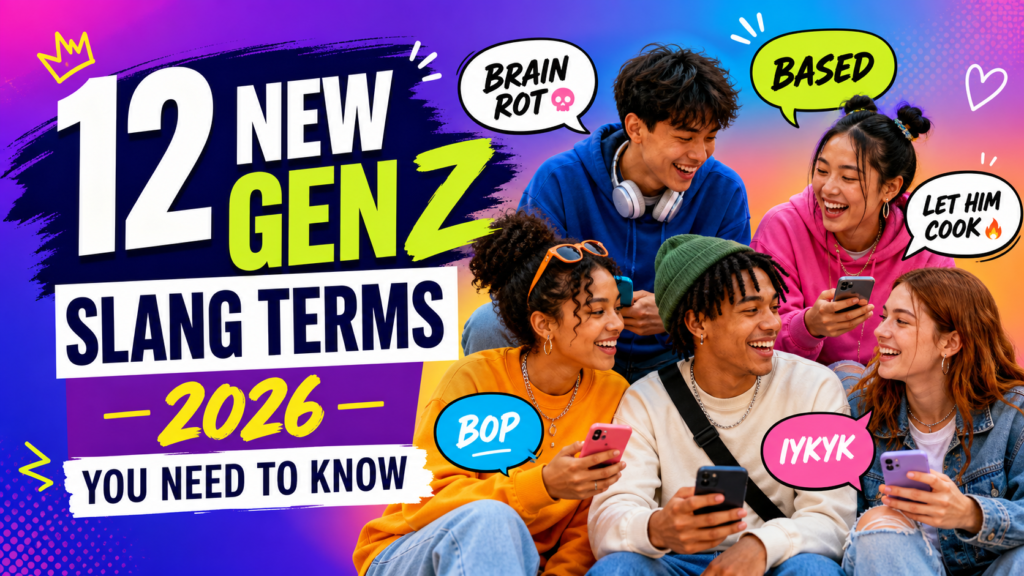
You have survived slay, mastered rizz, understood delulu, and probably heard “bro is cooked” at least once this week. But just when you think you are fluent in Gen Z language, the internet drops another set of words and suddenly the group chat looks like it needs subtitles- 12 new gen Z slang.
That is where this list comes in.
These new Gen Z slang terms are completely different from the words covered in our earlier blogs. No repeats. No recycled “no cap,” “lowkey,” “aura farming,” or “vibe check.” Just 12 fresh terms you may see in TikTok comments, gaming chats, memes, college corridors, and messages from friends who refuse to use normal English.
Ready? Let’s decode the internet before it decodes us.
1. Brain Rot- New Gen Z Slang terms
Meaning: The feeling of having your brain overloaded by too much repetitive, silly, or low-value online content. It can also describe the content itself.
Example: “I watched those clips for two hours. My brain rot is serious.”
Friend chat:
Ayaan: “Why are you saying that sound effect every five seconds?”
Zara: “Because it is stuck in my head.”
Ayaan: “That is not a personality. That is brain rot.”
Zara: “True. Send help.”
Brain rot is usually said as a joke. It does not mean someone is actually unintelligent—it means the algorithm has won for the day.
2. Fanum Tax
Meaning: Playfully taking a bite, sip, or small portion of your friend’s food without asking.
Example: “You brought fries? I’m collecting Fanum tax.”
Friend chat:
Mira: “I ordered one burger for myself.”
Rayan: “Perfect. I only need two bites.”
Mira: “That is not sharing.”
Rayan: “It is Fanum tax. Please respect the system.”
This is best used with close friends. In real life, make sure the other person is actually okay with sharing before claiming your “tax.”
3. Based
Meaning: Being confidently authentic, especially when sharing an honest opinion without worrying whether everyone agrees.
Example: “She said weekends should be three days long. That is a based opinion.”
Friend chat:
Nora: “I think school should start at 10 a.m.”
Omar: “Based.”
Nora: “Finally, someone understands.”
Omar: “I support this movement with my whole sleep schedule.”
Use based when someone says something bold, sensible, or refreshingly honest.
4. Opps
Meaning: Rivals, opponents, or people you are competing against. It is often used jokingly about sports teams, gaming opponents, or friendly competition.
Example: “Our football team is ready for the opps.”
Friend chat:
Ibrahim: “Who are we playing in the final?”
Sami: “The school across town.”
Ibrahim: “Say less. The opps have been identified.”
Coach: “Please remember it is a friendly match.”
Important: The term can have more serious meanings in some communities, so use it carefully. For everyday student content, keep it light and use it for games, sports, or playful rivalry.
5. Let Him Cook
Meaning: Let someone continue because they may be about to do something impressive, explain a great idea, or prove everyone wrong.
Example: “He is explaining his project idea—let him cook.”
Friend chat:
Teacher: “Why should we allow your group to present last?”
Adil: “Because our project has a surprise ending.”
Friend whispers: “Let him cook.”
Adil: “Thank you. The confidence is appreciated.”
This phrase is perfect for hyping up a friend who is clearly in their zone.
6. Womp Womp
Meaning: A humorous sound or phrase used to react to a small disappointment, setback, or mildly embarrassing moment.
Example: “You forgot your charger again? Womp womp.”
Friend chat:
Lina: “I studied the wrong chapter.”
Hana: “Womp womp.”
Lina: “That is not supportive.”
Hana: “I can be supportive after I stop laughing.”
Keep it friendly. Womp womp should never be used to dismiss someone’s real problem or serious feelings.
7. Bop
Meaning: A song that is catchy, exciting, and impossible not to enjoy.
Example: “This new track is a total bop.”
Friend chat:
Jay: “Why are you listening to the same song again?”
Ari: “Because it is a bop.”
Jay: “You played it 14 times.”
Ari: “Exactly. That is how you know it is good.”
If a song makes you want to replay it before it even ends, it is probably a bop.
8. Bussin’
Meaning: Extremely good—most commonly used for food, though it can also describe something that is impressive.
Example: “These loaded fries are bussin’.”
Friend chat:
Sara: “Try this dessert.”
Khalid: “Okay, wow. This is bussin’.”
Sara: “I told you.”
Khalid: “I would like to apologize for doubting the dessert.”
The safest place to use bussin’ is around great food. It is basically a five-star review in one word.
9. IYKYK
Meaning: Short for “if you know, you know.” It refers to an inside joke, shared experience, or reference that only some people will understand.
Example: “That last-day-of-school feeling… IYKYK.”
Friend chat:
Amal: “Remember what happened during the science fair?”
Rishi: “Please do not remind me.”
Amal: “The glue gun incident… IYKYK.”
Rishi: “Only five people know, and that is enough.”
Use it when you want to hint at a story without explaining every detail.
10. It’s Giving
Meaning: It resembles, suggests, or has the energy of something else.
Example: “This outfit is giving summer holiday.”
Friend chat:
Maya: “Why did you bring sunglasses to the library?”
Reem: “Because the look is giving mysterious main character.”
Maya: “It is giving you forgot your regular glasses.”
Reem: “Also true.”
This phrase is excellent for describing outfits, rooms, moods, playlists, and even suspicious behavior.
11. Sending Me
Meaning: Something is making you laugh a lot or react strongly because it is so funny.
Example: “That video is sending me.”
Friend chat:
Leo: “Did you see the cat wearing tiny sunglasses?”
Noah: “Yes. It is sending me.”
Leo: “Why are you laughing like you just won the lottery?”
Noah: “Because the cat had more confidence than I do.”
When something is “sending you,” it is usually so funny that you cannot stay serious.
12. Finsta
Meaning: A private or secondary Instagram account, often used to share casual, unfiltered, or more personal content with a smaller group of trusted friends.
Example: “I posted that on my finsta, not my public account.”
Friend chat:
Tara: “Why did you not post the picture on your main account?”
Zain: “It belongs on the finsta.”
Tara: “Is it that chaotic?”
Zain: “It is a blurry photo of us eating fries at midnight. So yes.”
A finsta can be a fun, private space, but it is still smart to think before posting—screenshots can travel fast.
Why New Gen Z Slang Matters
These terms may sound random at first, but they make conversations faster, funnier, and more expressive. From calling a great song a bop to telling a friend to let him cook, Gen Z slang turns ordinary reactions into memorable moments.
Slang also moves quickly because online communities shape language in real time. TikTok, gaming, memes, music, and group chats can turn a phrase into a worldwide trend within days. Current slang guides continue to document terms such as brain rot, Fanum tax, bop, bussin’, IYKYK, and based as part of evolving online language.englishcentral+1
How to Use These Terms Naturally
Using Gen Z slang is not about adding every word to one sentence. That is the fastest way to sound like a dictionary with Wi-Fi.
Try these simple rules instead:
- Use words you genuinely understand and enjoy.
- Match the setting—bussin’ works brilliantly for food; womp womp does not belong in a serious conversation.
- Use slang with friends who share the context.
- Keep private online spaces private, even when posting on a finsta.
- Let the conversation lead. If the moment does not call for slang, normal English is still a huge W.
Final Thoughts
Language is always changing, and Gen Z slang makes that change loud, funny, and full of personality. These 12 new Gen Z slang terms can help you understand more of what you see online, join conversations with confidence, and maybe even become the friend who explains the joke before everyone searches it.
So, next time the group chat says a song is a bop, someone is collecting Fanum tax, or your friend’s presentation has everyone saying “let them cook,” you will not be confused—you will be completely in the know.
Read more: 12 New Gen Z Slang Terms You Need to Know in 2026- Gen Z vs Gen Alpha: 12 Key Differences Explained
- Who Is Gen Z? Characteristics, Mindset, Behaviour & Expectations (2026 Guide)
- 16 Gen Z Slang Words You Haven’t Heard Yet: Meanings, Examples & Context (2026)
- 10 Gen Z Phrases Every Parent Should Know in 2026 (With Examples)
- Gen Z Happiness: 7 Signs Your Child Is Thriving (Not Just Surviving)