
Clear Communication Beats Corporate Mystery
A manager sends a vague message: “Please improve this soon.” The Gen Z employee asks, “What needs to improve, what does soon mean, and how will success be measured?”
That employee may not be challenging authority. They may be asking for the clarity required to do the work properly.
Managers who know how to communicate with Gen Z employees can reduce confusion, improve trust, and create stronger team performance. This is not about copying slang or treating younger employees as fragile. It is about clarity, context, feedback, trust, and human connection.
Gen Z is not one uniform group. Communication preferences vary by personality, role, culture, country, experience, and work environment. The best manager asks instead of assuming.
Start with Who Is Gen Z? Characteristics, Mindset, Behaviour & Expectations (2026 Guide).
Quick principle: Ask about communication preferences instead of guessing them.
[Clickable Table of Contents Placeholder]
10 Practical Tips to Communicate with Gen Z Employees
1. Be Clear About the Task and the Outcome
Action: State what needs doing, why it matters, who owns it, when it is due, and what good work looks like.
Avoid vague phrases such as “do it soon,” “make it better,” or “take ownership.” They can mean different things to different people.
Example: Instead of, “Please update the report soon,” say: “Please update the delay summary by 3 p.m. Wednesday. Include the top three causes, current impact, and one recommended action.”
Manager action: Define the task, deadline, owner, priority, and expected outcome.
2. Explain the “Why,” Not Only the “What”
Action: Give enough context for employees to prioritise and make sound decisions.
A task becomes easier to own when the employee understands its impact on a customer, quality standard, safety issue, deadline, project, or team goal.
Example: “This report is for tomorrow’s customer meeting, so accuracy matters more than adding extra design.”
Manager action: Connect daily work to a real outcome, not only a checklist.
3. Choose the Communication Channel Intentionally
Action: Match the channel to the message.
Instant messages work well for quick updates. Email or shared documents work better for detailed instructions and decisions. Video, voice, or in-person conversations are often better for sensitive feedback, complex decisions, development, and relationship-building.
Example: “Use Teams for the urgent update, then record the final decision in the project document.”
Manager action: Ask each employee, “What is the best channel for urgent updates, detailed instructions, and feedback?”
4. Give Feedback While the Work Is Still Fresh
Action: Make feedback timely, specific, respectful, and connected to the work.
Use a simple structure:
- What worked
- What needs to change
- What good looks like
- What happens next
Example: “The analysis is clear. Please add the source for the second figure and move the recommendation to the top. Send the revision by 2 p.m.”
Manager action: Do not save every correction for an annual review.
5. Replace Corporate Jargon With Direct Language
Action: Use plain language that a new employee can understand immediately.
Phrases such as “circle back,” “align on the deliverable,” and “socialise the deck” can create confusion, especially across cultures, languages, and experience levels.
Example: Instead of, “Let’s circle back and align on the deliverable,” say: “Let’s review the final two changes at 3 p.m.”
Manager action: Before sending a message, remove any phrase that needs translation or interpretation.
6. Make Questions Safe
Action: Treat good-faith questions as part of quality work.
Questions may show that someone is checking assumptions, spotting a risk, or trying to understand the standard. That is useful for every team.
Example: “What information would help you complete this correctly?”
Manager action: Reward early questions instead of only rewarding silent problem-solving.
A question can be inappropriate if it is disrespectful or repeatedly ignores a clear answer. However, a manager should separate that behaviour from a genuine request for context.
7. Provide Guidance Without Micromanaging
Action: Set clear outcomes, decision boundaries, check-in points, and access to help—then allow room for the employee to choose a sensible method.
This is especially important in hybrid and remote teams, where constant monitoring can create confusion and slow down work.
Example: “You own the dashboard layout. The required metrics are fixed, and we will review progress on Friday.”
Manager action: Manage the outcome, not every minute of the process.
8. Discuss Growth Regularly
Action: Talk about development during regular one-to-ones, not only at annual review time.
Ask what the employee wants to learn, what kind of work interests them, what feedback would help, and what experience may prepare them for the next step.
Example: “What is one skill you want to build this quarter, and where could you practise it in your current role?”
Manager action: Add one development question to every monthly one-to-one.
9. Respect Boundaries and Make Availability Clear
Action: Be specific about work hours, response expectations, urgent issues, escalation routes, meeting etiquette, and time-off boundaries.
Flexibility does not mean constant availability. Clear expectations help on-site, remote, and hybrid teams work without guesswork.
Example: “Messages after 6 p.m. do not need a reply unless marked urgent. For urgent operational issues, call the duty number.”
Manager action: Create communication rules that protect performance and wellbeing.
10. Listen, Close the Loop, and Show What Changed
Action: Asking for input without acting—or explaining why nothing can change—damages trust.
Use a simple sequence:
- Ask for input.
- Listen without interrupting.
- Explain what will change.
- Explain what cannot change and why.
- Follow up.
Example: “Three team members asked for clearer shift handover instructions. We updated the template and will review it after two weeks.”
Manager action: When feedback cannot lead to change, explain the reason openly.
A Simple Communication Formula for Managers
To communicate with Gen Z employees clearly, use this five-part formula:
Context + Clarity + Check-in + Choice + Close the Loop
- Context: Why does this task matter?
- Clarity: What must be done, by when, and to what standard?
- Check-in: When will progress or questions be discussed?
- Choice: Where can the employee decide the method?
- Close the loop: What happened after feedback or a decision?

Complete example:
“Tomorrow’s customer review needs an accurate delay summary. Please update the three priority causes by 11 a.m. Use the existing template, and choose the clearest way to show the trend. We will review it together at noon.”
This approach works with employees of every age because it removes guesswork without removing accountability.
What Managers Should Avoid
- Vague instructions
- Public criticism
- Feedback saved only for annual reviews
- Excessive meetings with no decision
- Assuming digital communication means poor communication
- Treating questions as disloyalty
- Promising growth without a clear pathway
- Contacting employees constantly outside agreed hours
- Using slang to appear relatable
- Assuming every Gen Z employee wants the same communication style
For a wider comparison of generational contexts, see Gen Z vs Gen Alpha: 12 Key Differences Parents and Teachers Should Know.
Does Gen Z Prefer Digital Communication?
Gen Z employees may be comfortable with digital tools, but digital comfort does not remove the need for human connection. The right channel depends on the person, topic, urgency, work setting, and relationship—not birth year alone.
Ask directly: “For project updates, feedback, and urgent issues, what communication approach helps you work at your best?”
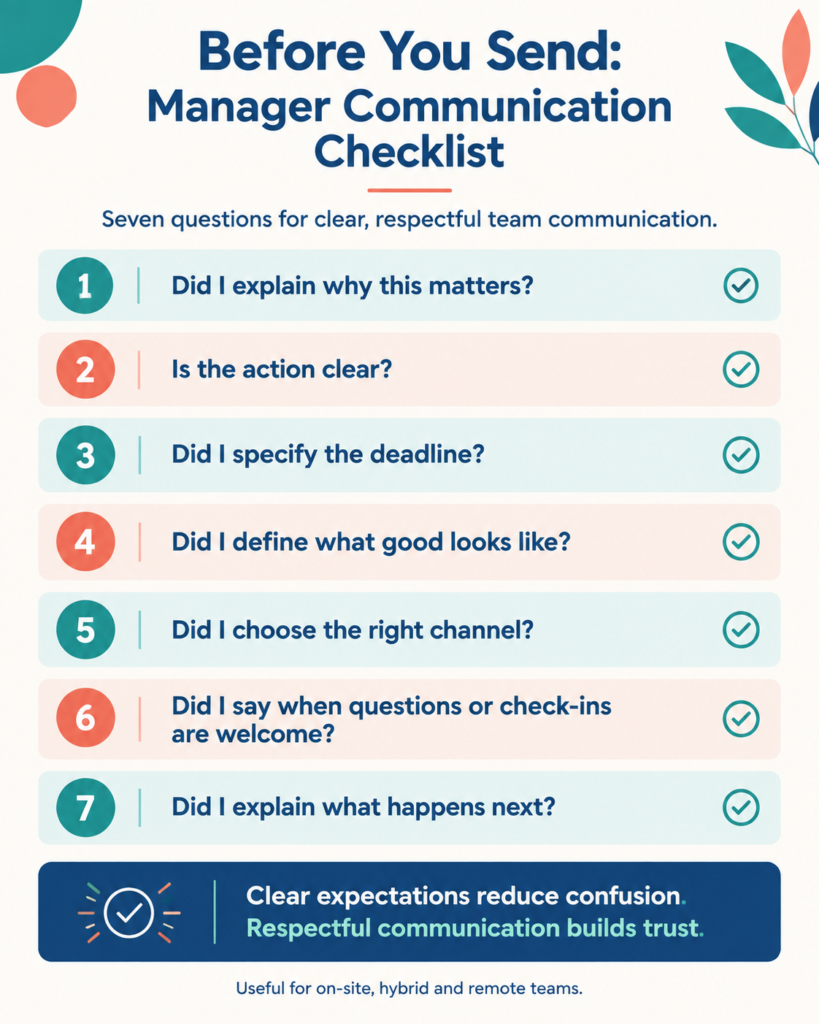
Final Checklist for Managers
| Before sending a message, ask: | Yes/No |
|---|---|
| Did I explain why this matters? | |
| Is the action clear? | |
| Did I specify the deadline? | |
| Did I define what good looks like? | |
| Did I choose the right channel? | |
| Did I state when questions or check-ins are welcome? | |
| Did I explain what happens next? |
Frequently Asked Questions
What is the best way to communicate with Gen Z employees?
The best way is to be clear, respectful, specific, and consistent. Explain the purpose of work, define the expected result and deadline, give timely feedback, and ask each employee which channels work best for different situations. Good communication should be adapted to the person and task, not their age label alone.
Does Gen Z prefer text messages at work?
Not necessarily. Many Gen Z employees are comfortable using chat tools, but comfort with messaging does not mean it is their preferred channel for every conversation. Complex feedback, sensitive issues, development discussions, and important decisions may work better through a voice, video, or face-to-face conversatio
How often should managers give Gen Z employees feedback?
Give feedback when it can still improve the work. Short, specific feedback after a project, milestone, or observed behaviour is usually more useful than waiting for an annual review. Agree on a reasonable check-in rhythm with each employee, based on their role, experience, workload, and preferences.
How can managers build trust with Gen Z employees?
Managers build trust by keeping commitments, being clear about expectations, respecting boundaries, making questions safe, giving fair feedback, and explaining decisions. Trust also grows when leaders ask for employee input and clearly communicate what changed—or why a requested change was not possible.
Final Thoughts
Learning to communicate with Gen Z employees is not about special treatment or generational trends. It is about good management: clear expectations, honest context, timely feedback, respect, autonomy, and consistent follow-through.
Gen Z employees do not need managers to use slang or copy their communication style. They need managers who remove unnecessary confusion, make it safe to ask questions, and treat them as capable professionals.
The strongest communication practices benefit every generation, every team, and every workplace—whether people work remotely, on-site, or across several locations.
What is one communication habit you would add to this list? Share it in the comments.
Share this guide with a manager or team leader who wants to build a clearer, stronger team. For a deeper guide, read Gen Z at Work—What They Expect From Managers, Teams and Careers.
- What Does 6–7 Mean in Gen Alpha Slang? Origin, Meaning and Examples
- 15 Gen Alpha Slang Terms in 2026 That Parents and Teachers Should Know
- Gen Z at Work: What They Expect From Managers, Teams and Careers
- How to Communicate with Gen Z Employees: 10 Tips for Managers
- How to Talk to Gen Z Teens: 10 Things Parents and Teachers Should Know
Pingback: How to Talk to Gen Z Teens: 10 Tips for Parents and Teachers