
Gen Z Is Not Anti-Work—They Are Questioning the Old Deal
A Gen Z employee asks: “What does success look like in this role?” “When will I receive feedback?” “Is there a path to develop?” “Why does this task matter?”
One manager may hear impatience. Another may hear a reasonable request for clarity, development, purpose, and a fair working relationship.
Gen Z at work is not about lowering standards or avoiding hard work. Many Gen Z employees are entering organisations during AI disruption, economic uncertainty, hybrid work, and changing career paths. They may be redefining ambition around skills, financial stability, flexibility, wellbeing, meaningful relationships, and sustainable progress.
Gen Z is not a single personality type. Communication and career preferences vary by country, culture, role, industry, experience, personality, and personal circumstances. The best manager asks instead of assuming.
“Gen Z is not rejecting ambition. They are asking whether the traditional price of ambition is worth paying.”
Who Is Gen Z in the Workplace?
Gen Z is commonly defined as people born around 1997–2012. In 2026, this includes teenagers entering their first jobs, university graduates, experienced professionals, specialists, entrepreneurs, and some early managers.
That is why broad claims can be misleading. A young retail worker, a nurse on shifts, a junior designer, a software developer, a teacher, and a logistics coordinator may all have very different workplace needs.
Read Who Is Gen Z? Characteristics, Mindset, Behaviour & Expectations (2026 Guide) for the wider social and cultural context.
What Has Shaped Gen Z’s Work Expectations?
Gen Z grew up during rapid digital change, social-media expansion, online learning, pandemic disruption, economic pressure, and the rise of AI. These influences do not define every employee, but they can help explain why clarity, skills, flexibility, fairness, and wellbeing feature strongly in workplace conversations.
What Gen Z Expects From Managers
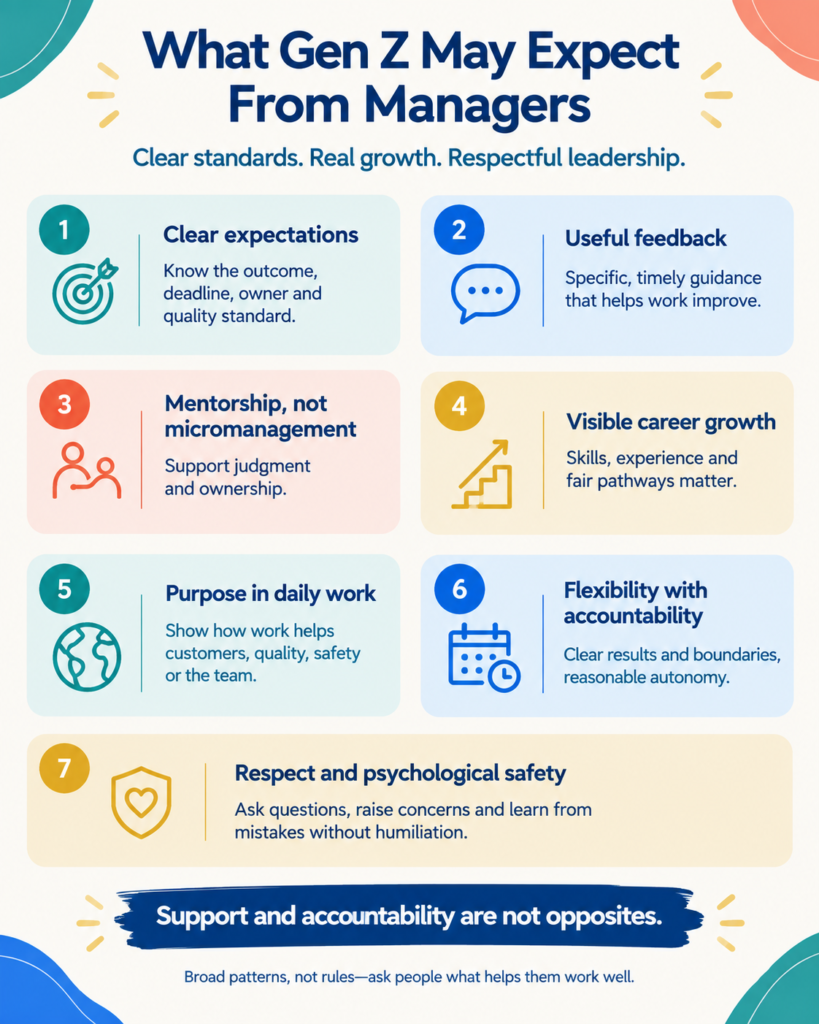
1. Clear Expectations
Employees work better when they understand the outcome, deadline, owner, priority, and quality standard.
Instead of: “Improve this report.”
Say: “Correct the three data gaps, add a short recommendation, and send the revised version by Thursday at noon.”
Manager action: State what good work looks like before work begins.
2. Feedback That Helps Them Improve
Many employees, including Gen Z workers, prefer useful feedback while the work is still fresh. Feedback should name what worked, what needs changing, and what happens next.
Example: “The analysis is accurate. Please move the recommendation to the top and add the source for the second figure.”
Manager action: Give specific guidance throughout the year—not only in annual reviews.
For a practical feedback framework, use How to Communicate with Gen Z Employees: 10 Tips for Managers.
3. Mentorship, Not Micromanagement
Gen Z employees may want support, access to expertise, and career guidance. They do not necessarily want a manager checking every small decision.
Example: “What support would help you make this decision?” is better than taking over the task.
Manager action: Set clear decision boundaries, then coach rather than control.
4. A Visible Path to Growth
Career growth does not always mean rapid promotion. It can mean a certification, more responsibility, new skills, a pay increase, lateral movement, project leadership, or deeper technical expertise.
Manager action: Discuss skills and next steps in regular one-to-ones.
5. Purpose Connected to Daily Work
A mission statement is not enough. Employees want to understand how their work affects customers, quality, safety, team results, revenue, or the wider community.
Example: “Accurate handover data helps prevent customer delays and allows the next team to work safely.”
Manager action: Explain why routine tasks matter.
6. Flexibility With Accountability
Flexibility may mean hybrid options, output-focused work, shift swaps, focus time, or support for personal responsibilities. However, flexibility does not mean unclear availability or missed deadlines.
Example: “You can complete the analysis from home or the office tomorrow. The customer-ready version is due by 4 p.m.”
Manager action: Agree on outcomes, availability, and boundaries—then allow reasonable autonomy.
7. Respect, Fairness, and Psychological Safety
Employees notice whether workload, recognition, scheduling, promotion, and rules are applied fairly. They also need to be able to raise a concern, admit an error, or ask for help without being mocked or humiliated.
Psychological safety does not remove accountability. It makes it easier to solve problems early.
Manager action: Correct privately, explain decisions honestly, and treat good-faith questions as useful information.
What Gen Z Expects From Teams
Managers shape culture, but teammates shape daily work.
| Team expectation | What it looks like |
|---|---|
| Respect | No mocking of age, accent, identity, background, or communication style |
| Reliability | People keep commitments and flag risks early |
| Collaboration | Information is shared instead of held back |
| Healthy conflict | Problems are discussed directly and professionally |
| Recognition | Contributions are acknowledged fairly |
| Boundaries | Urgent work is clearly separated from routine work |
Gen Z employees may use informal language in casual settings, but informal does not mean unprofessional. Teams should agree on standards for meeting etiquette, response times, documentation, escalation, and respectful communication.
What Gen Z Expects From Careers
Many Gen Z employees assess career opportunities through more than job titles. They may weigh pay, skills, career security, purpose, flexibility, wellbeing, advancement, and whether the work fits their broader life goals.
Common career priorities can include:
- Progress over status: Meaningful skill growth may matter more than a title alone.
- Skills alongside qualifications: Certifications, portfolios, digital tools, and practical experience can feel as valuable as credentials.
- Multiple routes to success: Some may choose entrepreneurship, technical specialisation, skilled trades, public service, freelancing, or further study.
- Leadership on their own terms: Not everyone wants rapid promotion or a leadership title immediately.
- Future-ready capability: AI literacy, communication, adaptability, ethical judgement, and analytical thinking matter alongside role-specific expertise.
What Managers Often Get Wrong
| Misconception | More useful interpretation |
|---|---|
| “They do not want to work hard.” | They may question unnecessary overwork while still valuing achievement and results. |
| “They want constant praise.” | They may want practical feedback that helps them improve. |
| “They are disloyal.” | They may leave when growth, fairness, wellbeing, or expectations remain unclear. |
| “They only want remote work.” | Many value flexibility while also needing mentoring, connection, and visibility. |
| “They cannot take criticism.” | Most employees respond better to clear, respectful, specific feedback. |
| “They are not ambitious.” | Many define ambition through skills, stability, purpose, and sustainable progress. |
How to Manage Gen Z Without Lowering Standards
Use this simple framework:
- Set high standards.
- Explain the purpose and success criteria.
- Provide support and timely feedback.
- Give reasonable autonomy.
- Hold people accountable consistently.“Support and accountability are not opposites. Good managers provide both.”
A practical scenario
A Gen Z employee misses a deadline.
Unhelpful response:
“Young employees have no commitment.”
Better response:
“The deadline was missed, which affected the team. What blocked progress, what is the recovery plan, and what needs to happen earlier next time?”
Empathy does not excuse missed work. It helps managers identify the issue and set a better standard for the future.
What Gen Z Employees Can Do
Workplace expectations are mutual. Gen Z employees can advocate for better management while also building professional trust.
- Ask for clarity early rather than guessing.
- Raise risks before a deadline is missed.
- Adapt communication to the audience and channel.
- Treat feedback as useful information, not automatically as a personal attack.
- Build skills beyond the tools you already know.
- Respect professional standards, time commitments, and boundaries.
- Learn from colleagues with different work styles and experience.
- Demonstrate reliability through follow-through.
This balance matters: employees can ask for flexibility, but they also need to show accountability.
Gen Z at Work in Multi-Generational Teams
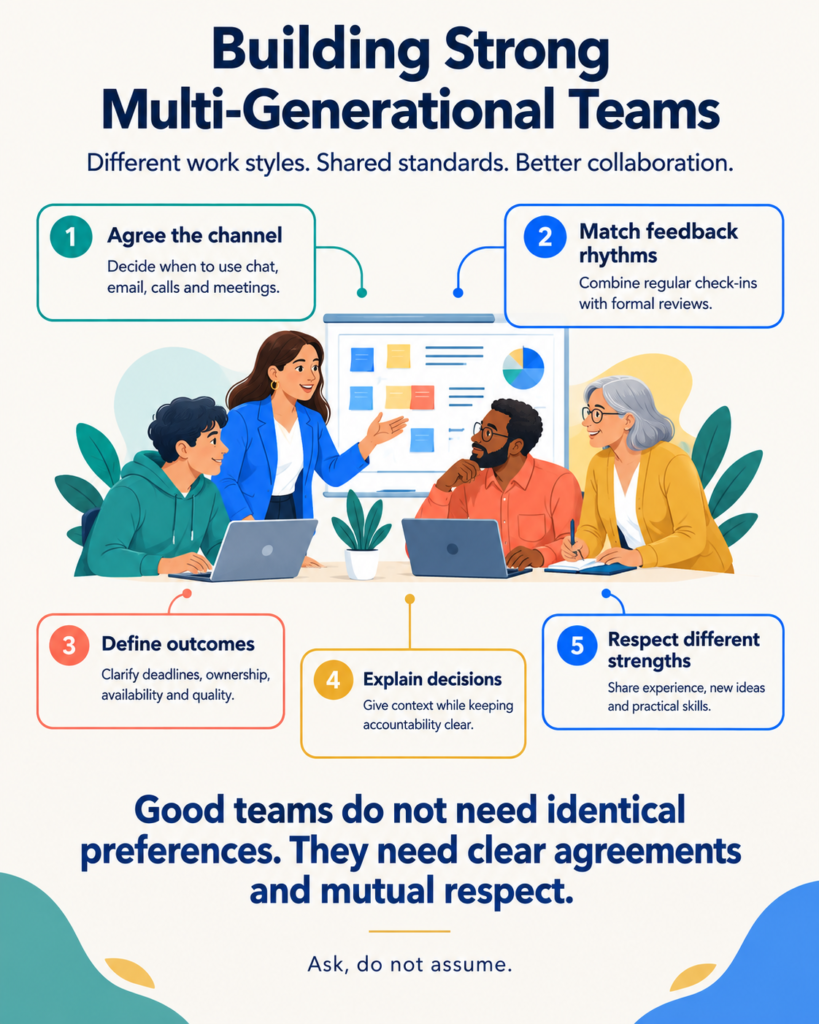
Generational differences do not need to become conflict. Teams work best when they agree on shared systems instead of assuming everyone prefers the same approach.
| Possible difference | Better team approach |
|---|---|
| Email versus chat preferences | Agree which channel is used for what purpose |
| Formal annual reviews versus regular feedback | Combine formal reviews with useful short check-ins |
| Office presence versus output focus | Define results, availability, and collaboration needs |
| Hierarchy versus explanation | Explain decisions while keeping accountability clear |
| Loyalty versus mobility | Discuss individual career goals rather than assuming commitment |
Frequently Asked Questions
What does Gen Z want from managers?
Many Gen Z employees value clear expectations, fair feedback, career development, respect, transparency, and managers who explain why work matters. Individual preferences vary, so managers should ask instead of relying only on generational assumptions.
Does Gen Z care about career growth?
Many do, although growth does not always mean quick promotion. It may include practical skills, certifications, pay growth, meaningful projects, lateral moves, increased responsibility, or a more sustainable role.
Does Gen Z prefer remote or hybrid work?
There is no single answer. Some prefer remote flexibility, while others value office learning, social connection, equipment, structure, and visibility. The best arrangement depends on the role, workplace, and individual situation.
How should managers give Gen Z employees feedback?
Give feedback early, specifically, and respectfully. Explain what worked, what needs changing, what the expected standard looks like, and what should happen next. Focus on work and behavior, not personality.
Is Gen Z less loyal than older generations?
Loyalty should not be judged by age. Employees of any generation may leave when growth, pay, fairness, wellbeing, job security, or management quality are poor. Organizations build commitment through trust and opportunity.
What skills should Gen Z develop for future careers?
Gen Z employees can benefit from communication, analytical thinking, digital and AI literacy, collaboration, resilience, adaptability, ethical judgement, curiosity, and lifelong learning. Technical capability and strong human skills will both remain valuable.
Final Thoughts: A Better Workplace for Every Generation
Gen Z at work is not a request to remove standards. Many Gen Z employees are asking for clarity, fairness, purpose, learning, flexibility, sustainable expectations, and managers who communicate honestly.
The best management practices for Gen Z—clear goals, useful feedback, mentorship, accountability, trust, human connection, and development—also make workplaces better for everyone. They are useful in retail, offices, healthcare, education, hospitality, logistics, manufacturing, technology, and remote or hybrid teams.
Managers should replace assumptions with questions. Gen Z employees should pair self-advocacy with reliability, adaptability, patience, and professional responsibility.
What is one expectation Gen Z brings to the workplace that every generation could benefit from? Share your view in the comments.
Share this guide with a manager, HR professional, team leader, or Gen Z colleague.
- What Does 6–7 Mean in Gen Alpha Slang? Origin, Meaning and Examples
- 15 Gen Alpha Slang Terms in 2026 That Parents and Teachers Should Know
- Gen Z at Work: What They Expect From Managers, Teams and Careers
- How to Communicate with Gen Z Employees: 10 Tips for Managers
- How to Talk to Gen Z Teens: 10 Things Parents and Teachers Should Know