Just When Adults Learn One Word, Five More Appear
A teacher hears students say “6–7,” “that is so skibidi,” and “you lost aura points.” A parent sees “crine” in a group chat and wonders whether it is a typo. An older sibling is told to “lock in” during a game.
Welcome to the fast-moving world of Gen Alpha slang terms.
These words spread through short-form video, livestreams, gaming, memes, music, creators, group chats, and online communities. They can sound confusing because many are designed to be exaggerated, ironic, absurd, or deliberately hard for adults to decode.
The goal is not to sound like a child. The goal is to understand the culture well enough to keep communication open.
This guide explains 15 Gen Alpha slang terms, including what they usually mean, how they may be used, when adults should be cautious, and how to respond without turning a harmless joke into a major conflict.
“Understanding the word is useful. Understanding the context is essential.”
Table
| What Is Gen Alpha Slang? |
| Quick Guide to 15 Gen Alpha Slang Terms |
| 15 Gen Alpha Slang Terms Explained With Examples |
| Which Terms Are Harmless, Sensitive, or Better Avoided? |
| How Parents and Teachers Can Respond Naturally |
| When Slang Becomes a Bullying or Safety Issue |
| Why Gen Alpha Slang Changes So Quickly |
What Is Gen Alpha Slang?
Gen Alpha commonly refers to children born roughly from 2010 to 2024 or 2025, although sources differ on exact birth-year boundaries. In 2026, the group includes young children, pre-teens, and teenagers.
Their slang may be shaped by gaming, YouTube, livestreams, short-form video, memes, music, online creators, and remix culture. Not every child uses every phrase, and the same word can have a different meaning across countries, platforms, languages, friendship groups, and age groups.
Some words in this guide were not created by Gen Alpha. They may come from earlier internet culture, gaming, music, Black cultural language, LGBTQ+ communities, or other online spaces. It is important not to erase those origins or assume every phrase belongs to one generation.
For a broader comparison, read Gen Z vs Gen Alpha: 12 Key Differences Parents and Teachers Should Know
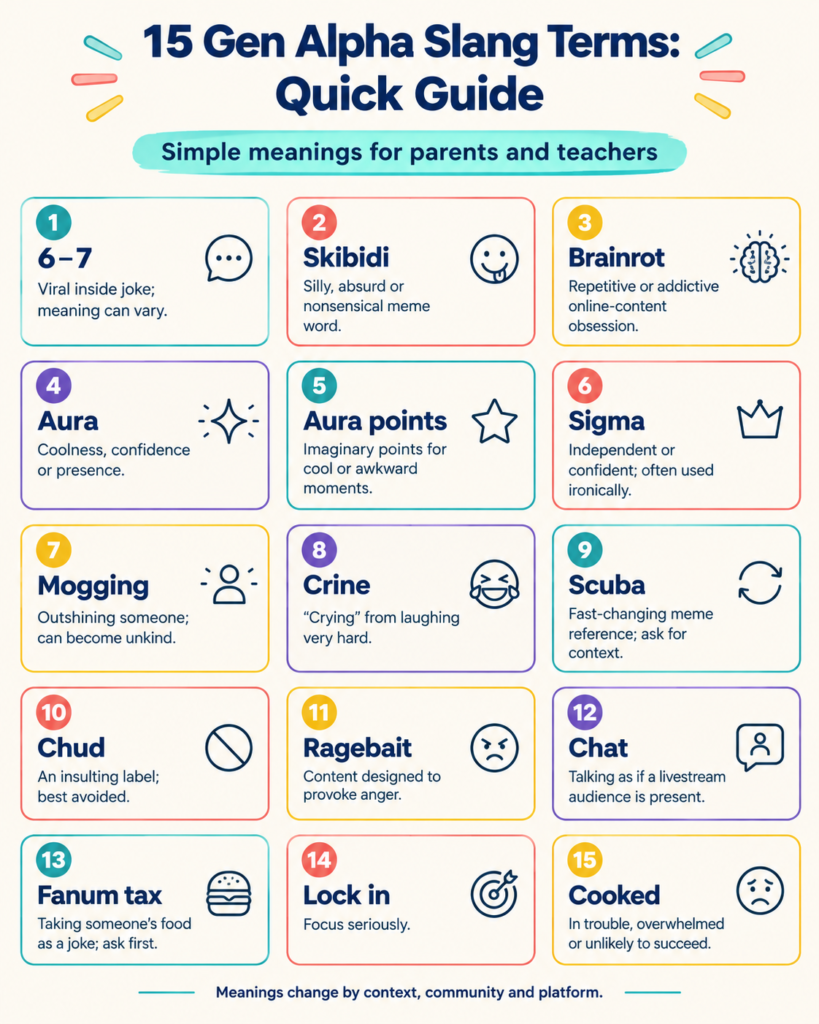
Quick Guide to 15 Gen Alpha Slang Terms
| Term | Simple meaning | Usual tone | Adult response |
|---|---|---|---|
| 6–7 | Viral phrase with no stable meaning | Playful, absurd | Ask what it means in that group |
| Skibidi | Nonsense meme word; can suggest weird or silly | Humorous, ironic | Ask whether it means funny, strange, or negative |
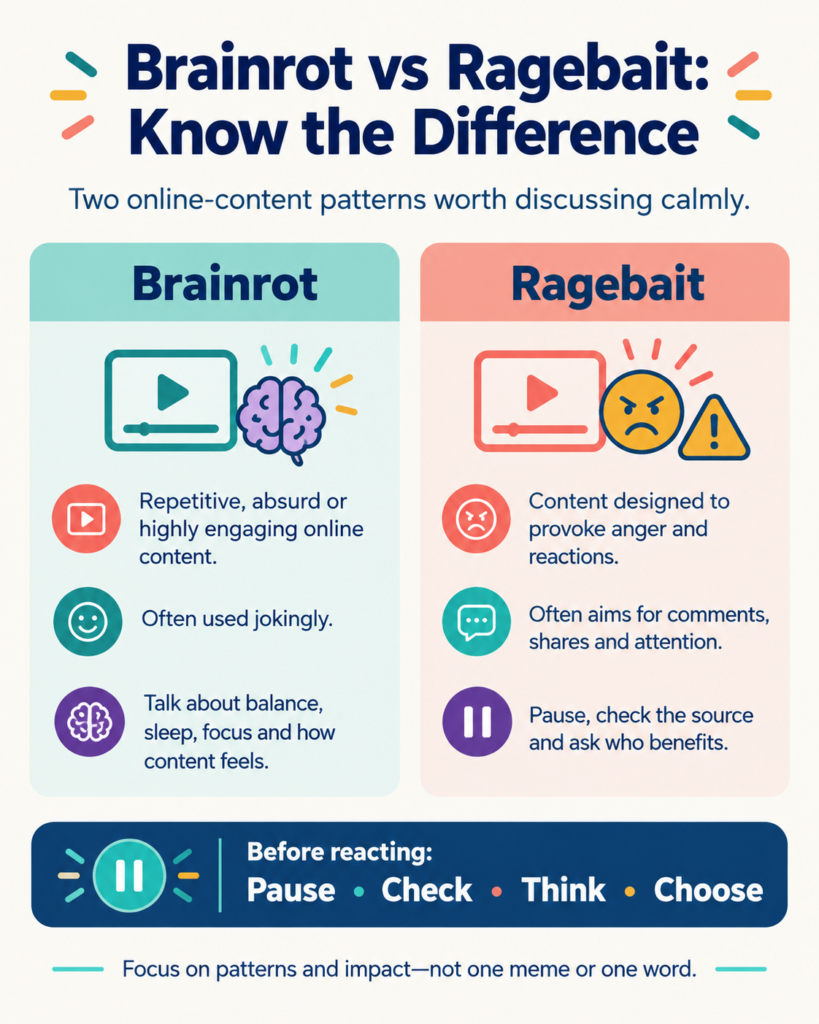
| Brainrot | Repetitive, low-value or addictive online content | Joking, sometimes critical | Discuss balance without shame |
| Aura | Coolness, confidence, presence | Positive or teasing | Ask what created the “aura” |
| Aura points | Imaginary points for looking cool or awkward | Playful, exaggerated | Watch for repeated humiliation |
| Sigma | Independent or confident person; often ironic | Meme-based, context-dependent | Ask what the speaker means |
| Mogging | Outshining someone in looks, status or performance | Competitive, can be hurtful | Redirect appearance comparisons |
| Crine | Intentional “crying” misspelling for extreme laughter | Playful | Understand; no need to copy it |
| Scuba | A fast-changing meme reference that may vary by community | Context-dependent | Ask, then verify current use |
| Chud | Insult for an unpleasant or foolish person | Rude, derogatory | Do not normalise it |
| Ragebait | Content designed to provoke anger and engagement | Media-literacy term | Pause before reacting or sharing |
| Chat | Speaking as if viewers in a livestream are present | Playful, performative | Recognise its gaming/livestream origin |
| Fanum tax | Taking a share of someone’s food as a joke | Playful if consensual | Reinforce asking permission |
| Lock in | Focus seriously | Positive, motivating | Encourage a practical plan |
| Cooked | Exhausted, in trouble or unlikely to succeed | Dramatic, often joking | Check context and wellbeing |
15 Gen Alpha Slang Terms Explained With Examples
1. 6–7
What it means: “6–7” is a viral phrase whose meaning is often intentionally unclear. It may function as a joke, sound, reference, or random response rather than a word with a fixed definition.
How it is used: You may hear it in classrooms, games, group chats, sports settings, and comment sections. It can be shouted or written simply because the phrase is recognised as a meme.
Example:
Teacher: “Why did you write 6–7 in the class chat?”
Student: “No reason—it is just the joke.”
Tone and context: Usually playful and absurd. Its lack of clear meaning is often the point.
Should adults repeat it? Better to understand than repeat.
Helpful adult response:
“Okay, I can see that is an inside meme. What does it mean in your group?”
Important note: Current reporting links the phrase to online meme culture and Skrilla’s “Doot Doot (6 7),” but its use shifts quickly. Confirm context before making assumptions.dispatch+2
2. Skibidi
What it means: “Skibidi” is a nonsense internet term. Depending on context, it may suggest something silly, weird, absurd, awkward, funny, or occasionally negative.
How it is used: It may appear in gaming, short videos, memes, school conversations, and comments. It is often used for humorous effect rather than precision.
Example:
“That video was completely skibidi.”
Tone and context: Mostly ironic and playful. It often has no exact meaning.
Should adults repeat it? Use only with awareness of context.
Helpful adult response:
“Do you mean that was funny, strange, or something else?”
3. Brainrot
What it means: “Brainrot” often describes repetitive, absurd, low-effort, or highly engaging online content. People also use it jokingly to describe being overly focused on memes, a game, or a trend.
How it is used: You may hear it when children repeat a meme, quote a creator, or admit they have watched the same silly clips repeatedly.
Example:
“I watched the same ten-second meme for an hour. Total brainrot.”
Tone and context: Usually humorous and self-aware. It is not a medical diagnosis.
Should adults repeat it? Generally safe to understand and use lightly.
Helpful adult response:
“That meme really stayed in your head. Is it funny, or is it making it harder to focus on other things?”
Important note: If online habits are repeatedly affecting sleep, relationships, learning, safety, or daily functioning, start a calm conversation instead of shaming the child. Merriam-Webster describes brain rot as both low-quality digital content and fixation on it, but slang use should not be treated as a mental-health diagnosis.
4. Aura
What it means: “Aura” refers to perceived coolness, confidence, presence, style, or charisma.
How it is used: It may be used after a confident performance in sport, school, music, gaming, or a social situation.
Example:
“She walked into the competition with serious aura.”
Tone and context: Usually positive, though it can be teasing if someone says another person “lost aura.”
Should adults repeat it? Generally safe to understand and use lightly.
Helpful adult response:
“What gave her that confidence—her preparation, her style, or the way she handled the moment?”
Important note: “Aura” language can be fun, but it should not become a ranking system that repeatedly humiliates someone.
5. Aura Points
What it means: “Aura points” are imaginary points someone gains or loses for appearing confident, impressive, kind, awkward, or embarrassing.
How it is used: Friends may use it after a small social moment, successful goal, funny mistake, or kind action.
Example:
“Helping the new student find the classroom gave you 100 aura points.”
Tone and context: Usually exaggerated and playful.
Should adults repeat it? Generally safe to understand and use lightly.
Helpful adult response:
“That was a kind choice. We do not need points to recognise it, but I can see why your friends noticed.”
Important note: If “aura loss” becomes a repeated way to target one child, treat it as a respect issue rather than harmless humour.
6. Sigma
What it means: “Sigma” can describe someone portrayed as independent, confident, self-directed, or unconcerned with social approval. It is also frequently used randomly or ironically as a meme.
How it is used: You may hear it in gaming, class jokes, short videos, or comments about someone doing their own thing.
Example:
“He brought his lunch, ignored the drama, and finished his project. Very sigma.”
Tone and context: Often humorous or ironic rather than a serious compliment.
Should adults repeat it? Better to understand than repeat.
Helpful adult response:
“When you say ‘sigma,’ do you mean independent, or are you using it as a joke?”
Important note: In some spaces, “sigma” connects to online “alpha male” content. Adults can use it as an opportunity to discuss confidence without ranking people by gender, popularity, or status.
7. Mogging
What it means: “Mogging” means outshining or appearing more impressive than another person. It may refer to looks, fashion, height, confidence, performance, or social presence.
How it is used: You may see it in comments, video edits, sport discussions, or appearance-based comparisons.
Example:
“He thinks the actor is mogging everyone in that scene.”
Tone and context: Competitive and often exaggerated. It can become hurtful when used to compare real people’s bodies or looks.
Should adults repeat it? Avoid using it directly.
Helpful adult response:
“Are you talking about confidence and style, or are people comparing someone’s body or appearance?”
Important note: Merriam-Webster notes that mog originally often referred to looking better than someone in a photo, while newer use can mean to outclass or outperform. Avoid normalising appearance comparisons in class or at home.
8. Crine
What it means: “Crine” is an intentional misspelling of “crying.” It usually means something is extremely funny.
How it is used: It often appears in text messages, comments, group chats, and captions.
Example:
“That comment was so unexpected—I’m crine.”
Tone and context: Playful and informal.
Should adults repeat it? Better to understand than repeat.
Helpful adult response:
“You found that really funny. What happened?”
Important note: Intentional spelling changes are part of online humour. They do not necessarily mean a child cannot spell or does not understand formal writing.
9. Scuba
What it means: In some fast-moving 2026 online slang use, “scuba” may refer to a dance, gesture, or reaction connected to something smelling bad or unpleasant. However, usage appears limited and may vary quickly between communities.
How it is used: It may appear in a meme, game, group chat, or classroom joke.
Example:
“The cafeteria mystery smell had everyone doing the scuba.”
Tone and context: Usually silly and visual.
Should adults repeat it? Use only with awareness of context.
Helpful adult response:
“I have not heard that one. What does ‘scuba’ mean in your group?”
Important note: Because this term is rapidly changing and not universal, verify its current meaning and source before publication or classroom discussion.
10. Chud
What it means: “Chud” is an online insult for someone considered foolish, unpleasant, rude, or obnoxious.
How it is used: It may appear in comment sections, gaming disputes, political arguments, or online fights.
Example:
“You may see someone call another person a chud in a comment section.”
Tone and context: Derogatory and insulting.
Should adults repeat it? Avoid using it directly.
Helpful adult response:
“That word is being used as an insult. Let’s describe the behaviour we disagree with without attacking the person.”
Important note: The term has older cultural and political associations in some contexts. It should not be normalised as harmless classroom language. Current slang reporting describes it as an insult for an obnoxious or unlikeable person.
11. Ragebait
What it means: “Ragebait” is content deliberately designed to provoke anger so people comment, argue, share, watch longer, or generate attention.
How it is used: It may describe an obviously unfair opinion, provocative video, misleading post, or creator who seems to want an argument.
Example:
“That creator posted an obviously unfair opinion just to start arguments. It was ragebait.”
Tone and context: A useful media-literacy term.
Should adults repeat it? Generally safe to understand and use lightly.
Helpful adult response:
“Before replying, ask: is this person sharing a real view, or trying to get attention through anger?”
Important note: Pause before sharing. Check the source, look for missing context, and ask who benefits from the extra attention.
12. Chat
What it means: “Chat” is used as if an invisible livestream audience is watching. Someone may say “Chat, is this real?” while speaking to friends, family, or classmates.
How it is used: It comes from livestream and gaming culture and has moved into ordinary conversation.
Example:
“Chat, should I send this message?”
Tone and context: Playful, performative, and usually harmless.
Should adults repeat it? Generally safe to understand and use lightly.
Helpful adult response:
“You are talking like you have an audience. What would ‘chat’ say?”
Important note: This term shows how livestream culture can influence everyday speech. It is not necessarily a sign that a child spends too much time online.
13. Fanum Tax
What it means: “Fanum tax” is a humorous phrase for taking a bite, portion, or “tax” from someone else’s food.
How it is used: It may come up at lunch, at home, in gaming conversations, or in creator-related jokes.
Example:
“You took one of my fries—that is the Fanum tax.”
Tone and context: Playful if everyone agrees.
Should adults repeat it? Generally safe to understand and use lightly.
Helpful adult response:
“That is funny, but ask first. Food is not automatically shared.”
Important note: The joke should never justify taking food without permission, especially if someone has allergies, health needs, limited food, or has said no.
14. Lock In
What it means: “Lock in” means to focus seriously, remove distractions, and commit to a task or goal.
How it is used: It can be used for school, sport, gaming, work, training, creative projects, or exams.
Example:
“I have exams next week. Time to lock in.”
Tone and context: Usually positive and motivating.
Should adults repeat it? Generally safe to understand and use lightly.
Helpful adult response:
“Good plan. What would help you lock in for the next 30 minutes?”
Important note: This is one slang term adults can translate into a practical plan: one task, one time limit, and fewer distractions.
15. Cooked
What it means: “Cooked” may mean exhausted, overwhelmed, in trouble, doomed, or likely to fail.
How it is used: It may be used after missing a deadline, forgetting homework, losing a game, or facing a difficult test.
Example:
“I forgot the deadline and now I am cooked.”
Tone and context: Dramatic and often joking.
Should adults repeat it? Generally safe to understand and use lightly.
Helpful adult response:
“That sounds stressful. Are you joking, or do you need help making a recovery plan?”
Important note: One dramatic phrase is usually just slang. Repeated hopeless language combined with major changes in mood, sleep, friendships, schoolwork, or safety deserves a supportive check-in.
Which Terms Are Harmless, Sensitive, or Better Avoided?
| Usually playful | Context-dependent | Better understood than repeated |
|---|---|---|
| Aura | 6–7 | Chud |
| Aura points | Skibidi | Mogging when aimed at appearance |
| Crine | Sigma | Any insult aimed at a real person |
| Fanum tax—with permission | Brainrot | Terms used to shame bodies, identity, gender, or sexuality |
| Lock in | Scuba | Any phrase used to bully, threaten, or exclude |
| Chat | Cooked |
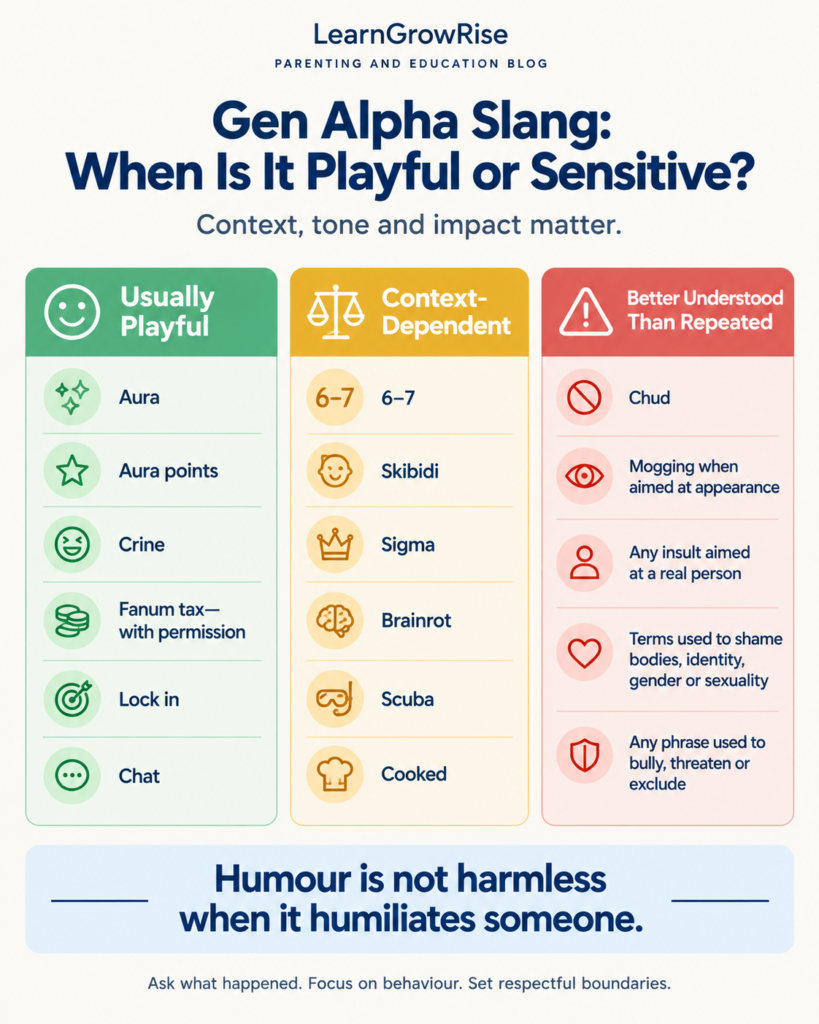
“Harmless” does not mean every use is appropriate. Tone, target, setting, and repetition matter. A joke among close friends can become humiliating when used repeatedly at one person’s expense.
Adults do not need to repeat a word simply because it appears in a slang list. Teach children to distinguish humour from humiliation.
“Curiosity is better than panic.”
How Parents and Teachers Can Respond Naturally
- Ask for context.
Say: “I have heard that phrase, but what does it mean in your group?” - Do not panic over nonsense words.
Some phrases are deliberately meaningless memes. A calm question works better than a public lecture. - Focus on behaviour when a term is insulting.
Say: “Let’s talk about what happened without attacking someone’s appearance or identity.” - Teach digital media literacy.
Discuss ragebait, screenshots, privacy, algorithms, ads, misleading captions, and online reputation. - Set boundaries without insulting the child’s language.
Say: “You may use that phrase with friends, but our classroom discussion needs respectful language.” - Look at patterns, not one word.
One slang expression cannot reveal a child’s personality, intelligence, wellbeing, or values. Persistent changes in sleep, relationships, mood, safety, learning, or daily functioning deserve calm attention.
For a wider guide to youth wellbeing and communication, read Gen Z Happiness: 7 Signs Your Child Is Thriving (Not Just Surviving.
When Slang Becomes a Bullying or Safety Issue
Slang becomes a concern when it shifts from playful group language into repeated insults, targeted harassment, sexualised comments, discriminatory language, threats, exclusion, or unsafe online behaviour.
Use this simple response framework:
- Name the behaviour. “That comment targeted someone’s appearance.”
- Ask what happened. Listen before deciding what to do.
- Check who was affected. Make sure the targeted child has support.
- Set a clear boundary. Explain what language or behaviour is not acceptable.
- Repair harm where possible. Encourage a sincere apology and changed behaviour.
- Escalate when needed. Follow school safeguarding procedures or seek appropriate local support for serious, repeated, threatening, discriminatory, or sexualised behaviour.
Do not shame a child publicly. Do not assume every unfamiliar phrase is dangerous. At the same time, do not dismiss bullying, threats, sexual harassment, hate speech, or safety concerns as “just slang.”
Why Gen Alpha Slang Changes So Quickly
Short-form video can spread a phrase worldwide in days. Gaming and livestream communities create shared language. Memes are remixed rather than used in one fixed form, while recommendation systems and AI-generated content can speed up repetition.
A phrase may be popular for weeks, then vanish—or return with a new meaning. Different countries and online communities can also use the same word differently.
“By the time an adult has mastered one phrase, the algorithm may already be promoting the next one.”
For more context on different digital childhoods, read Gen Z vs Gen Alpha: 12 Key Differences Parents and Teachers Should Know]. You can also compare current language trends through 15 Fresh Gen Z Slang Terms to Know in 2026] and 12 New Gen Z Slang Terms You Need to Know in 2026.
What is Gen Alpha slang?
Gen Alpha slang refers to informal words, jokes, abbreviations, and meme-based expressions used by some children and younger teenagers. It often spreads through gaming, video platforms, livestreams, group chats, and creators. Meanings vary by country, community, age group, and platform, so one definition may not fit every situation.
What does “6–7” mean?
“6–7” is usually a viral meme phrase with no stable dictionary meaning. It may be used as a joke, sound, or group reference rather than a precise statement. Its current popularity is linked to music and viral online clips, but its use changes quickly.dispatch+1
What does “skibidi” mean?
“Skibidi” is a nonsense internet term associated with absurd meme culture. It can suggest something silly, weird, funny, awkward, or occasionally negative, depending on context. It often has no exact meaning, so adults should ask what the speaker means rather than assuming.
What does “aura” mean in Gen Alpha slang?
In slang, “aura” usually refers to someone’s coolness, confidence, style, charisma, or presence. “Aura points” are imaginary points gained or lost after a socially impressive or awkward moment. It is often playful, but repeated “aura loss” comments can become embarrassing or unkind.
What does “brainrot” mean?
“Brainrot” usually refers to repetitive, absurd, low-effort, or highly engaging online content, or the joking feeling of being overly absorbed in it. It is slang, not a diagnosis. If online behaviour repeatedly affects sleep, safety, relationships, learning, or daily functioning, adults should discuss the pattern calmly.
What does “sigma” mean?
“Sigma” can describe someone portrayed as independent, confident, or unconcerned with popularity. It is also frequently used ironically or randomly in memes. In some spaces, it connects to “alpha male” content, so adults should ask what a child means and encourage respect rather than status-based judgment
What does “mogging” mean?
“Mogging” means outshining someone else, often in appearance, confidence, fashion, physical presence, or performance. It can be used jokingly, but it may encourage unhealthy comparisons when aimed at real people’s bodies or looks. Adults should discourage appearance-based ranking and comments that embarrass others.
What does “ragebait” mean?
Ragebait is online content designed to provoke anger and generate comments, shares, views, or arguments. It may involve an obviously unfair opinion, misleading claim, or deliberately irritating performance. A helpful habit is to pause, check the source, and ask who benefits from the attention before reacting.
What does “Fanum tax” mean?
“Fanum tax” is a playful phrase for taking a small share of someone else’s food, such as a fry or snack. It is only funny when the other person agrees. Children should still ask before taking food, especially when someone has allergies, health needs, or has clearly said no.
Final Thoughts: Understand the Culture, Not Just the Words
Gen Alpha slang terms are not a fixed dictionary. They are moving parts of online culture, shaped by memes, gaming, video, music, livestreams, friendship groups, and constant remixing.
Parents and teachers do not need to speak like children to connect with them. They need curiosity, calm questions, clear boundaries, and the confidence to address language that becomes hurtful, sexualised, discriminatory, or unsafe.
One word cannot define a child’s personality, intelligence, wellbeing, or values. Understanding context helps adults recognise humour, ask better questions, identify bullying, and keep communication open.
The best response is simple: listen first, ask what a word means in that group, and focus on how the language affects people.
Which Gen Alpha slang term has confused you the most? Share it in the comments—and ask a young person what it means in their online world.
Share this guide with a parent, teacher, grandparent, or colleague who wants to understand Gen Alpha better.
Pingback: Gen Z Slang Cheat Sheet: 10 Common Terms Explained