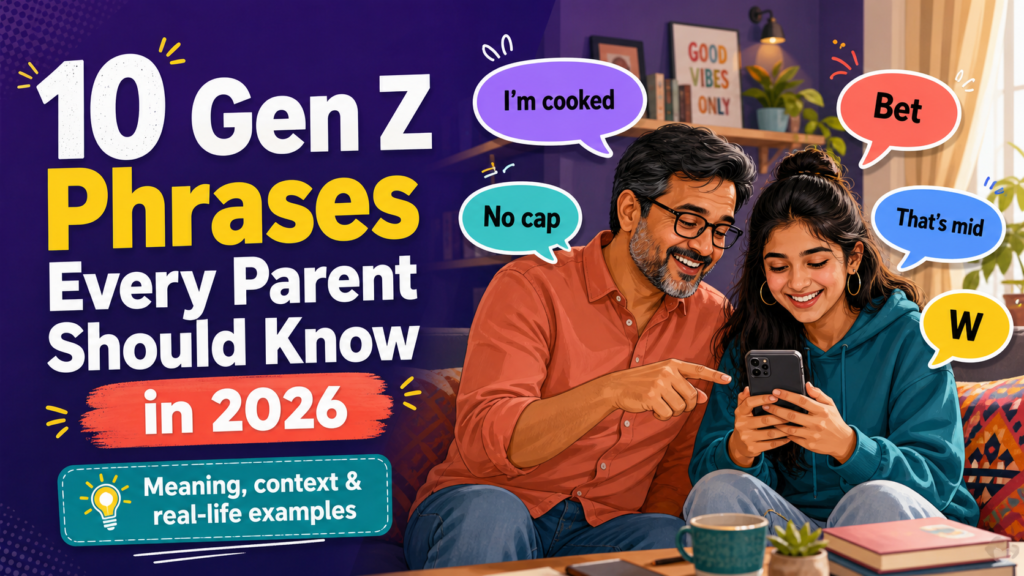
When Every Word Sounds Like English—But Nothing Makes Sense
Your teenager walks in after an exam and says:
“I’m cooked after that paper, but Riya absolutely ate her presentation. No cap.”
You understand every word separately. Yet together, it sounds like the exam involved a kitchen disaster, a performance, and a serious discussion about honesty.
Welcome to Gen Z communication.
These Gen Z phrases every parents should know are not “bad English.” They are part of a fast-moving online language shaped by social media, memes, gaming, music, group chats, short-form videos, and digital communities. They help young people express excitement, stress, humour, disappointment, support, and sarcasm in a few quick words.
The goal of this guide is not to make parents start saying “slay” at breakfast. That may earn you a long stare from your child. The goal is to understand the emotion and meaning behind the phrase, so language does not become a wall between you.
Before decoding slang, read Gen Z Happiness: 7 Signs Your Child Is Thriving (Not Just Surviving) for a bigger-picture guide to Gen Z wellbeing and parent-child connection.
Core message: You do not need to speak like Gen Z to connect with them. You only need to understand the words well enough that language does not become a wall between you.
Why Parents Should Understand Gen Z Phrases in 2026
Slang is not just vocabulary. It can be a shortcut for belonging.
Young people use Gen Z phrases to make friends laugh, react to a difficult day, show excitement, comment on a trend, or signal that they understand an inside joke. A phrase that looks confusing to a parent may be completely normal in a friend group.
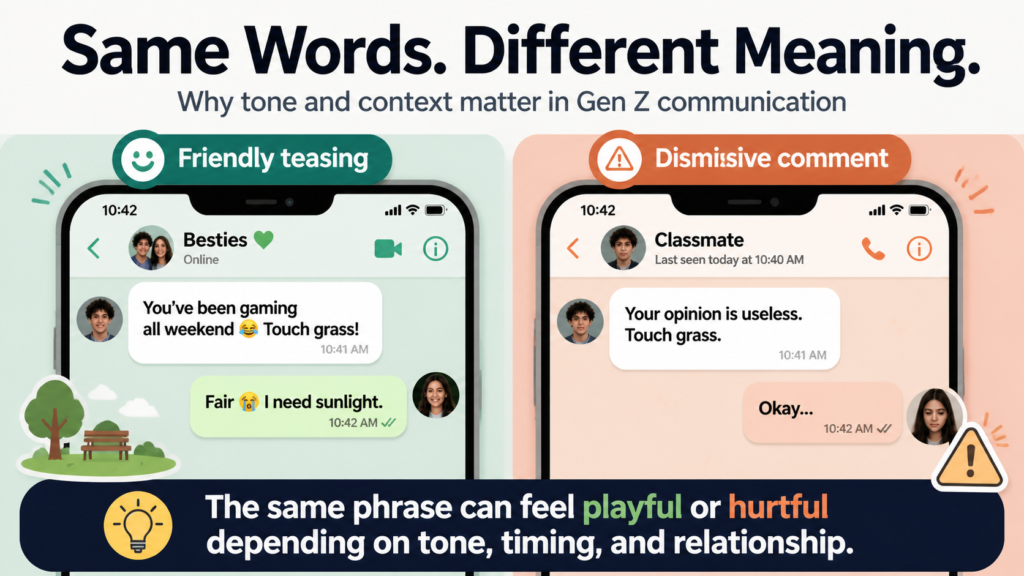
However, the same phrase can mean different things depending on tone, timing, emojis, the relationship between speakers, and the platform. A friend saying “touch grass” after a three-hour gaming session may be teasing. A stranger saying it during an argument may be dismissive.
Some phrases also come from specific cultural communities, music scenes, gaming culture, fandoms, and online spaces. They should be understood with respect, not treated as random “internet words” to copy without context.
“Understanding the language matters more than speaking the language.”
Trying too hard to use slang can sound forced. Your child does not need you to say “W parenting” every time you make dinner. They are more likely to appreciate a natural response such as, “Tell me more,” “That sounds stressful,” or “I can see why you are excited.”
Important
A single word, text message, emoji, or meme cannot reveal whether a young person is happy or struggling. Look at ongoing patterns in behaviour, relationships, sleep, school or work functioning, and safety—not one phrase. For broader parent-child wellbeing guidance, see [External Link: Reputable youth mental-health resource].
10 Gen Z Phrases Parents Should Know
The following Gen Z phrases are common in many online conversations, but usage varies by city, culture, school, college, platform, and friend group. Not every Gen Z person uses every term.
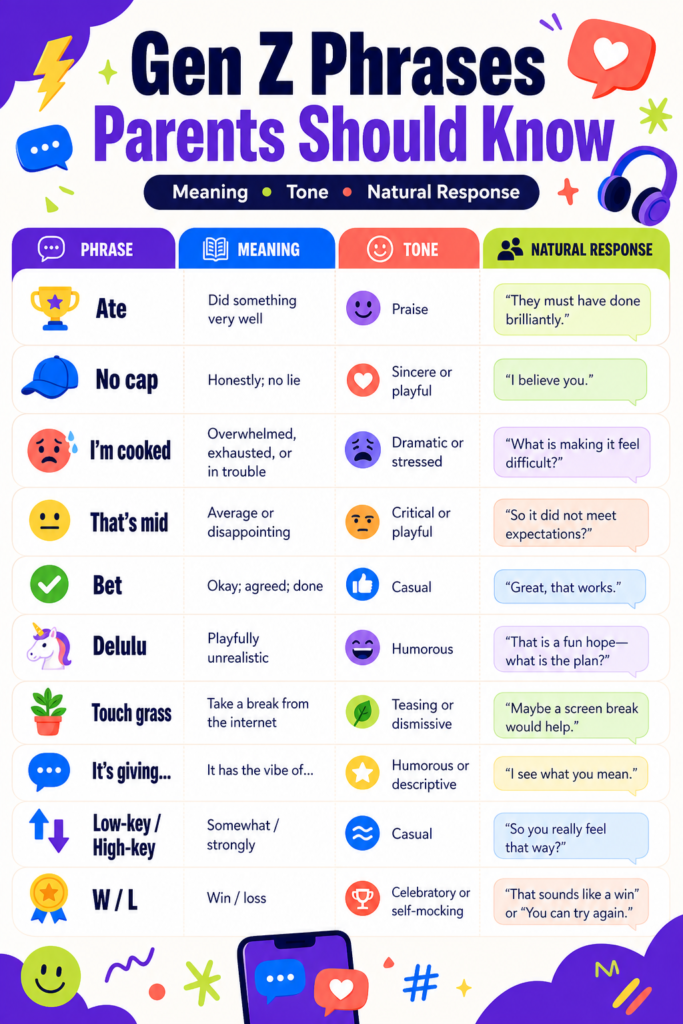
Gen Z Phrases Parents Should Know: Meanings, Examples and Responses
1. “Ate”
What it means: “Ate” means someone did something exceptionally well. It is usually enthusiastic praise.
Real-life example: “Neha ate that dance performance.”
Indian family example: “Your cousin ate that speech at the school annual day.”
What it usually means emotionally: Admiration, excitement, and genuine support.
What a parent can say naturally: “She must have performed really well. Show me the video if you want.”
Should parents use it? You can use it occasionally, but saying “You ate that homework” may not be necessary. “You did a great job” works perfectly.
2. “No Cap”
What it means: “No cap” means “I am being honest” or “no lie.”
Real-life example: “No cap, that was the hardest test this year.”
Indian family example: “No cap, the maths paper was much tougher than last year.”
What it usually means emotionally: The speaker wants to emphasise that they are serious.
What a parent can say naturally: “I believe you. What made it so difficult?”
Should parents use it? Better to understand it than use it often. It does not mean your child was lying before; it simply adds emphasis.
3. “I’m Cooked”
What it means: “I’m cooked” can mean overwhelmed, exhausted, unprepared, in trouble, or unlikely to succeed.
Real-life example: “I have two assignments, a project deadline, and a test tomorrow. I’m cooked.”
Indian family example: “I forgot the college project is due tomorrow. I’m cooked.”
What it usually means emotionally: Often dramatic humour. However, it can also signal genuine stress.
What a parent can say naturally: “Sounds like you are under pressure. What is still left to do?”
Should parents use it? Understand it, but use it lightly.
A casual “I’m cooked” after an exam is not automatically a warning sign. But if your child repeatedly expresses hopelessness alongside major changes in sleep, mood, school, work, or relationships, a calm check-in is wise.
4. “That’s Mid”
What it means: “Mid” means average, disappointing, or not as good as people claimed.
Real-life example: “Everyone hyped that movie, but it was mid.”
Indian family example: “That new café was mid. The Instagram photos were better than the food.”
What it usually means emotionally: A quick negative review. It can be playful when used about a movie, song, game, or event.
What a parent can say naturally: “So it did not live up to the hype?”
Should parents use it? Better to understand than use.
Calling a person “mid” can be unkind because it turns a casual opinion into a personal put-down.
5. “Bet”
What it means: “Bet” means okay, agreed, done, or challenge accepted.
Real-life example: “Meet outside at 6?” “Bet.”
Indian family example:
Parent: “Please be home by 10.”
Child: “Bet.”
What it usually means emotionally: Agreement. It is usually not disrespectful.
What a parent can say naturally: “Great. Thank you for confirming.”
Should parents use it? Yes, occasionally, but only if it feels natural. A parent saying “Bet, I’ll make parathas” is not wrong—just expect your teenager to smile.
6. “Delulu”
What it means: “Delulu” is a playful short form of “delusional.” Friends often use it for unrealistic hopes, celebrity crushes, or harmless fantasies.
Real-life example: “I’m delulu enough to think I can finish this assignment in one hour.”
Indian family example: “Your brother is delulu if he thinks he can pack for the trip in five minutes.”
What it usually means emotionally: Light humour, self-awareness, or teasing.
What a parent can say naturally: “That is ambitious. What is a more realistic plan?”
Should parents use it? Better to understand than use.
Do not use delulu to dismiss genuine anxiety, distress, or mental-health concerns. A joke about finishing homework quickly is very different from a child sharing a serious worry.
7. “Touch Grass”
What it means: “Touch grass” is a joking way of telling someone to take a break from the internet and reconnect with real life.
Real-life example: “You have been arguing about that game online for three hours. Touch grass.”
Indian family example: “Your cousin has watched 40 cricket analysis videos today. He needs to touch grass.”
What it usually means emotionally: Friendly teasing between close friends—or a dismissive comment if used during an argument.
What a parent can say naturally: “You have been online for a while. Want to take a walk or have tea with me?”
Should parents use it? Understand it, but use it gently. A calm invitation works better than shaming.
8. “It’s Giving…”
What it means: “It’s giving…” means something creates the mood, impression, or visual feeling of something else.
Real-life example: “That presentation is giving last-minute panic.”
Indian family example: “This outfit is giving wedding guest, even though we are only going to a cousin’s birthday.”
What it usually means emotionally: Usually humorous, visual, and expressive.
What a parent can say naturally: “Yes, I see the look you are going for.”
Should parents use it? You can use it occasionally. It is one of the easier phrases to understand because it simply means, “This reminds me of…”
9. “Low-Key” and “High-Key”
What they mean:
- Low-key means somewhat, quietly, privately, or mildly.
- High-key means openly, strongly, clearly, or intensely.
Real-life examples:
“I low-key liked that movie.”
“I high-key need a holiday.”
Indian family example: “I low-key want to stay home this weekend.” Or, “I high-key need chai before I can think.”
What they usually mean emotionally: These phrases help a young person soften or emphasise an opinion.
What a parent can say naturally: “So you enjoyed it more than you expected?” or “You clearly need a break.”
Should parents use them? Yes, occasionally. These are among the most parent-friendly phrases because they are easy to understand and use without forcing the moment.
10. “W” and “L”
What they mean:
- W means a win, success, or something positive.
- L means a loss, disappointment, failure, or awkward outcome.
Real-life examples:
“The professor gave us an extension. Huge W.”
“I missed the bus and forgot my lunch. Big L.”
Indian family example: “Finding a seat on the metro during rush hour was a W.” Or, “Getting rain on the day of the family picnic was an L.”
What they usually mean emotionally: Usually playful, quick reactions.
What a parent can say naturally: “That sounds like a win.” Or, “It did not go your way today, but you can try again.”
Should parents use them? Yes, occasionally. Just avoid calling a person an “L.” A situation can be disappointing; a child should not feel defined by one.
For more Gen Z language, explore :15 Fresh Gen Z Slang Terms to Know in 2026 and [Internal Link: 12 New Gen Z Slang Terms You Need to Know in 2026.
Context Changes Everything
Parents should never interpret a phrase in isolation. Tone, relationship, platform, and timing all change meaning.
Scenario 1: “I’m Cooked”
Casual: “I have two assignments tomorrow. I’m cooked.”
This may simply mean, “I am stressed and I have a lot to do.”
More serious: “Nothing matters. I’m cooked.”
This calls for a gentle response:
“That sounds really heavy. Do you want to tell me what is making things feel impossible right now?”
Scenario 2: “Touch Grass”
Friendly joke: “You have been gaming all weekend. Touch grass!”
Dismissive comment: “Your opinion is useless. Touch grass.”
The words are the same. The relationship and tone are not.
Scenario 3: “That Was Mid”
Light opinion: “That film was mid.”
Hurtful criticism: “You are mid.”
A review of a movie is different from a personal insult.
“Ask what they mean before deciding what they mean.”
How Parents Can Respond Without Sounding Cringe
1. Ask With Curiosity, Not Suspicion
Try:
“I have heard that phrase before, but what does it mean here?”
“Teach me this one—I want to understand.”
This makes language a conversation, not a test.
2. Listen for the Feeling Behind the Phrase
“I’m cooked” may mean stress. “That was mid” may mean disappointment. “Huge W” may mean relief.
The phrase is often a clue to the feeling, not the whole story.
3. Avoid Turning Every Word Into a Lecture
If each phrase becomes a debate about manners, social media, or “how we spoke in our time,” your child may stop sharing.
You do not need to approve of every word. You only need to stay connected.
4. Use Your Own Natural Language
You do not need to say “slay” or “bet” to communicate well.
Try:
“Tell me more.”
“That sounds stressful.”
“I understand why you are disappointed.”
“I am listening.”
These responses build trust more reliably than borrowed slang.
5. Respect Privacy While Staying Available
Teenagers and young adults need room to think, talk to friends, and manage parts of life independently. Respecting privacy does not mean disappearing emotionally.
Try:
“You do not have to talk now. I am here when you are ready.”
A family dialogue:
Child: “Mom, I’m cooked. I have a college project deadline tomorrow.”
Unhelpful response: “Stop talking nonsense and start studying.”
Better response: “Sounds stressful. Do you want help planning the next few hours, or do you just need a break first?”
When a Parent Should Check In More Deeply
Slang itself is not a warning sign.
However, check in calmly when concerning language appears alongside prolonged withdrawal, major sleep changes, hopelessness, loss of interest, falling academic or work performance, risky behaviour, threats, self-harm references, or safety concerns.
You do not need to panic. You do not need to diagnose. Start with a steady question:
“I have noticed you seem more overwhelmed lately. I care about you. Is there anything you want to talk about?”
If concerns continue or safety is at risk, consider contacting a trusted mental-health professional, school counsellor, or healthcare provider.
For a broader guide to positive wellbeing and connection, read Gen Z Happiness: 7 Signs Your Child Is Thriving (Not Just Surviving).
Why Gen Z Language Changes So Fast
TikTok, Instagram Reels, YouTube Shorts, gaming communities, streaming culture, music, memes, and group chats can make a phrase popular around the world in days.
Some words stay for years. Others disappear after a few weeks. Not every phrase belongs only to Gen Z, and not every Gen Z person uses the same language.
By the time you confidently use a new phrase, Gen Z may already have moved on. That is part of the game.
The best approach is curiosity, not memorisation. Understanding how different generations communicate can also help families and workplaces avoid unnecessary misunderstandings. All Generations Explained: Birth Years, Characteristics & Mindset (2026 Guide).
Frequently Asked Questions
Is it okay for parents to use Gen Z phrases?
Yes, but use them sparingly and naturally. Understanding a phrase matters more than forcing it into every conversatio
What does “no cap” mean?
It means “I am telling the truth” or “no lie.” It is usually used for emphasis.
Is “delulu” offensive?
It can be playful among friends, but it can feel dismissive. Avoid using it to minimise genuine feelings, anxiety, or mental-health concerns.
What does “I’m cooked” mean in Gen Z slang?
It commonly means overwhelmed, exhausted, unprepared, in trouble, or unlikely to succeed in a situation. Context determines whether it is a joke or an expression of real stress.
Why does Gen Z use so much slang?
Slang helps young people build humour, belonging, identity, and quick emotional expression in digital spaces.
Is Gen Z slang different from Gen Alpha slang?
There is overlap. However, Gen Alpha language is often influenced more directly by gaming, short-form video, memes, and AI-native digital experiences.
Should I worry if my child uses slang I do not understand?
No. Not understanding a word is normal. Ask calmly what it means. Focus on broader behaviour and wellbeing, not one unfamiliar phrase.
Final Thoughts: Connection Matters More Than Being Cool
Parents do not need to master every Gen Z phrase, trend, meme, or emoji. The goal is not to imitate your child’s vocabulary. It is to understand the intent and emotion behind the words.
When parents stay curious, young people are more likely to explain, share, and return to conversation after a hard day. When every unfamiliar word becomes a lecture, communication can close down.
The most valuable Gen Z phrases every parents should know are not only the ones in this list. They are also the everyday words that show your child is stressed, excited, proud, disappointed, or hoping you will understand.
Curiosity, respect, and calm listening build stronger communication than trying to sound young ever will.
Which Gen Z phrase confused you the most? Share it in the comments—and ask your child what it means before the internet changes it again.
If this guide helped, share it with a parent, teacher, grandparent, mentor, or friend. For more starter vocabulary, visit Gen Z Slang Cheat Sheet: 10 Common Slang Words You Need to Know.
- Gen Z vs Gen Alpha: 12 Key Differences Explained
- Who Is Gen Z? Characteristics, Mindset, Behaviour & Expectations (2026 Guide)
- 16 Gen Z Slang Words You Haven’t Heard Yet: Meanings, Examples & Context (2026)
- 10 Gen Z Phrases Every Parent Should Know in 2026 (With Examples)
- Gen Z Happiness: 7 Signs Your Child Is Thriving (Not Just Surviving)