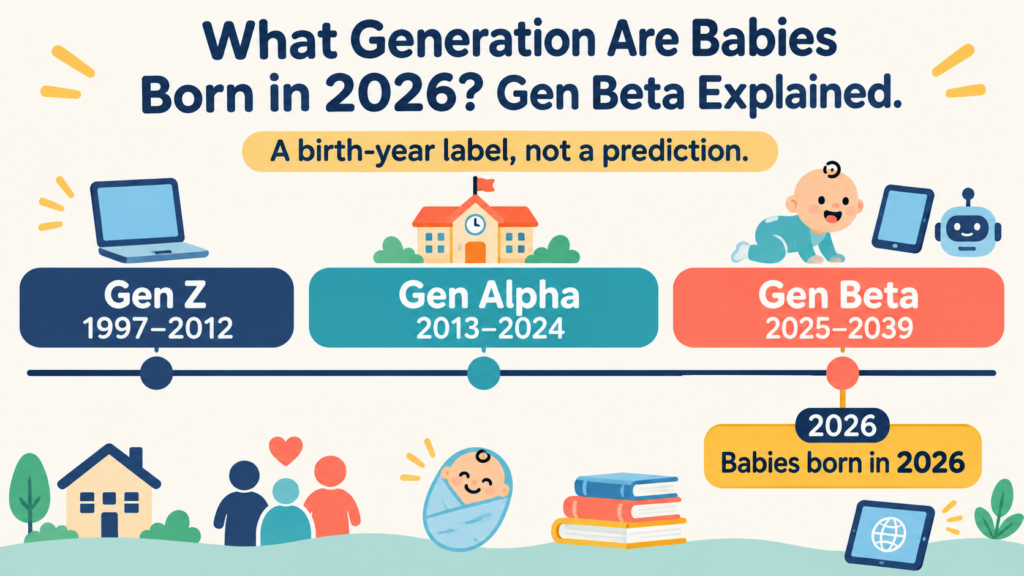
A baby born in 2026 is not Gen Z—and, under LearnGrowRise’s established timeline, is not Gen Alpha either. Meet Generation Beta.
What generation is 2026? Babies born in 2026 belong to Generation Beta. The Gen Beta birth years are 2025–2039, a range defined by McCrindle. Generational boundaries vary by source, so this is an attributed classification rather than an official worldwide rule.
The label may feel unfamiliar because Gen Beta’s birth-year range only began in 2025. It is a useful way to group birth years—not a description of every child born during that period.
What Is Generation Beta?
Generation Beta, or Gen Beta, is the generation following Gen Alpha. In McCrindle’s framework, it covers people born from 2025 through 2039.
The basic Generation Beta meaning is a birth-cohort label. It does not predict whether a child will be creative, patient, outgoing or especially good at finding your missing phone.
Alpha and Beta follow the Greek-letter naming sequence. McCrindle uses this sequence after earlier letter-based labels, including Generation X, Y and Z.
The 2039 endpoint is part of McCrindle’s proposed framework. It is not an observed historical turning point or a promise that children’s experiences will suddenly change in 2040.
Read the original definition in McCrindle’s introduction to Generation Beta.
Gen Z, Gen Alpha and Gen Beta at a Glance
This table follows the birth-year ranges used in LearnGrowRise’s existing generation guide.
| Generation | Birth years used in LearnGrowRise’s guide | Where 2026 fits |
|---|---|---|
| Gen Z | 1997–2012 | Earlier generation |
| Gen Alpha | 2013–2024 | Immediately before Gen Beta |
| Gen Beta | 2025–2039 | Includes babies born in 2026 |
For the wider timeline, explore All Generations Explained.
Why Do Generation Birth Years Differ Between Sources?
Generation boundaries are interpretive research conventions, not natural dividing lines. There is no single worldwide authority assigning an official generation to every birth year. Pew Research Center notes that generational categories are not scientifically defined and can encourage stereotypes or oversimplification.
Some frameworks use regular year blocks. Others consider historical events, cultural shifts and formative experiences when choosing boundaries. That does not mean every generation everywhere lasts exactly 15 years.
A child born just before a cutoff is not fundamentally different from one born just after it. Geography, family, culture, education and individual circumstances matter too.
Use generation labels as reference points, not biological categories, personality tests or rules for understanding every child.
Gen Alpha vs Gen Beta: What Is the Difference?
In LearnGrowRise’s established timeline, Gen Alpha covers 2013–2024, while Gen Beta covers 2025–2039. A baby born in 2024 is therefore Alpha; a baby born in 2026 is Beta.
The Gen Beta range is attributed to McCrindle, which defines the cohort as people born from 2025 to 2039. Today, the clearest difference is the assigned birth-year range and current life stage.
It is too early to make reliable claims about fixed differences in personality, intelligence, behaviour or learning style.
For background on the preceding generations, read Gen Z vs Gen Alpha. It does not establish Gen Beta’s future traits.
What Can We—and Can’t We—Say About Babies Born in 2026?
The useful distinction is between a birth-year classification and predictions about people whose lives are just beginning.
What we can say:
- They fall within the Gen Beta range in McCrindle’s framework.
- They are being born during ongoing technological and social change.
- Their experiences will differ substantially across families and countries.
- Their formative experiences are still ahead of them.
What we cannot yet establish:
- That they will be smarter or more digitally skilled than earlier generations.
- Their future personality or attention span.
- Their preferred careers, working arrangements or leadership styles.
- Their values, resilience or mental health as a generation.
- That every child will have access to AI, advanced devices or the same opportunities.
McCrindle discusses possible influences on Gen Beta, including technology, sustainability and changing social norms. These are predictions or expectations—not observed traits of children who are still very young.
A generation label describes a birth cohort. It does not tell you who an individual child will become.
Quick FAQs
What generation is 2026?
Babies born in 2026 belong to Generation Beta in LearnGrowRise’s timeline. The Gen Beta range, 2025–2039, is defined by McCrindle. Generational boundaries vary by source, so this is an attributed classification rather than an official worldwide rule.pewresearch+1
What are the Gen Beta birth years?
McCrindle defines Gen Beta as people born from 2025 through 2039, inclusive. That is the framework used for Gen Beta in this article, rather than a timeline assembled from different sources.
Are all babies born after 2024 Gen Beta?
Not indefinitely. In McCrindle’s framework, Gen Beta runs from 2025 to 2039. “After 2024” identifies its starting point, not an unlimited range covering every future birth.
Does being Gen Beta predict a child’s future?
No. A generation label can help organise discussion about shared historical circumstances, but it cannot determine an individual child’s abilities, interests or future. Generational labels can also encourage oversimplification.
For a baby born in 2026, Gen Beta is the answer within LearnGrowRise’s established timeline and McCrindle’s Gen Beta definition. Keep the attribution—and leave plenty of room for the individual behind the label.