
A Gen Z university student searches YouTube for a tutorial, compares different opinions online, and uses AI to improve a first draft. Their Gen Alpha sibling asks a voice assistant a question, learns through an interactive app, talks with friends while gaming, and expects a personalised answer almost immediately.
That is the heart of Gen Z vs Gen Alpha. Both groups grew up online, but they did not grow up in the same digital world.
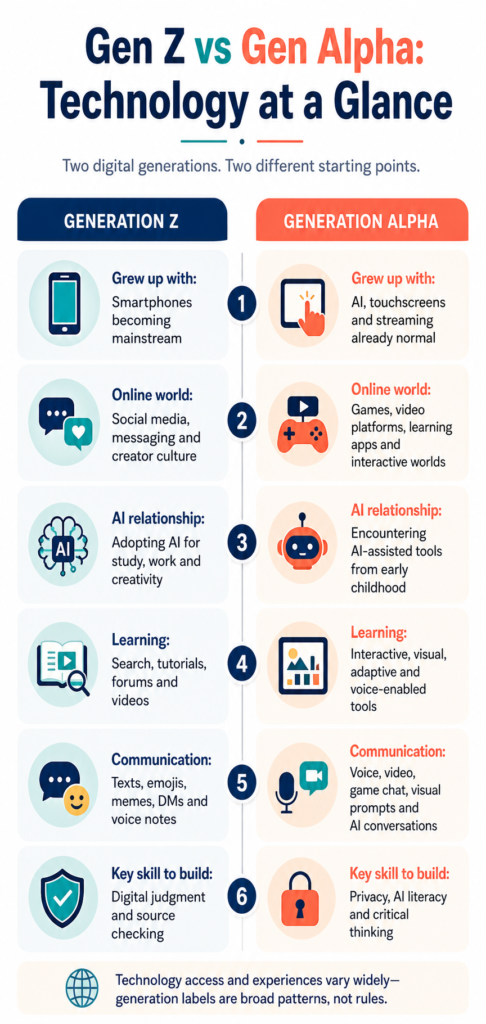
Gen Z saw smartphones, social media, streaming, and creator culture transform daily life. Gen Alpha is growing up with AI, touchscreens, gaming platforms, algorithmic feeds, and personalised technology already woven into childhood.
This guide explains the important differences in their technology use, learning, communication, expectations, and wellbeing—plus practical ways parents and teachers can support both.
Important: Generational labels describe broad social patterns, not fixed personality types. Culture, family circumstances, income, education, location, technology access, personality, and life experience can matter as much as birth year.
“Gen Z learned to live with the internet. Gen Alpha is learning to live with AI.”
Who Are Gen Z and Gen Alpha?
Gen Z is commonly defined as people born around 1997–2012, while Gen Alpha is commonly placed around 2010–2025. The overlap shows why these labels are guides rather than exact scientific categories. Pew’s framework sets Gen Z’s starting point at 1997, while other sources use slightly different boundary years.guides.
In 2026, Gen Z is approximately 14–29 years old, and Gen Alpha is approximately 1–16 years old. Older Gen Z members are already studying, working, building careers, starting businesses, and becoming parents. Gen Alpha members are still mainly children and teenagers, so predictions about their future should remain careful.
| Category | Generation Z | Generation Alpha |
|---|---|---|
| Common birth-year range | Approximately 1997–2012 | Approximately 2010–2025 |
| Approximate age in 2026 | Around 14–29 | Around 1–16 |
| Childhood technology | Smartphone, social-media and streaming growth | Touchscreens, AI tools, gaming and algorithmic feeds |
| Major disruption | Social-media expansion, economic uncertainty and pandemic disruption | Pandemic-era learning, AI acceleration and highly personalised media |
| Main life stage today | Teen years to working adulthood | Childhood to teenage years |
Britannica describes Gen Alpha as the first generation to experience remote classrooms, portable digital devices, streaming services, and AI-related tools from early childhood. This does not mean every child has the same access, but it helps explain their wider environment.
Read the full timeline in All Generations Explained: Birth Years, Characteristics & Mindset (2026 Guide).
Gen Z vs Gen Alpha at a Glance
The main difference is not simply screen time. It is the type of technology, the age at which it appears, and the social setting around it.
| Area | Generation Z | Generation Alpha | What adults can do |
|---|---|---|---|
| Technology | Grew up as smartphones became normal | Grows up with digital tools as a default | Teach digital judgment, not just device use |
| AI | Often adopts AI for study, work and creativity | May meet AI tools from early childhood | Teach accuracy, privacy and responsible use |
| Learning | Search, video tutorials, forums and creators | Interactive, visual, adaptive and voice-enabled tools | Combine technology with reading and discussion |
| Communication | Texts, memes, emojis, DMs and voice notes | Voice, video, game chat and visual prompts | Practise clear writing, listening and face-to-face skills |
| Entertainment | Streaming, social media, gaming and creators | Games, video, interactive media and creator content | Encourage balance, rest and offline activity |
| Future outlook | Making career and financial decisions amid change | Preparing for work that is still evolving | Build adaptable skills and confidence |
What Both Generations Share
- Digital connection and global content exposure.
- Visual communication and short-form media.
- Interest in belonging, creativity, fairness, and authenticity.
- Possible pressure from comparison, information overload, and online expectations.
- A need for trusted adults, boundaries, rest, movement, play, and real relationships.
12 Key Differences Between Gen Z and Gen Alpha
1. Digital Natives vs AI Natives
Gen Z grew up as smartphones, social platforms, and streaming became mainstream. Gen Alpha is growing up with AI assistants, adaptive apps, voice interfaces, and generative tools as familiar parts of daily life.
Why it matters: Neither group is automatically an expert. Knowing how to use an app is different from understanding privacy, accuracy, bias, safety, or ethical AI use.
Practical takeaway: Teach one habit early: ask where information came from and how it can be checked.
2. Social Media First vs Platform-Blended Childhood
Gen Z culture was deeply shaped by public profiles, messaging, creators, and social platforms. Gen Alpha’s online experience may blend games, video platforms, streaming, learning apps, interactive worlds, and creator content.
Why it matters: Adults should ask what children are doing online, not only how long they spend there. Gaming, watching, learning, chatting, and creating are different experiences with different benefits and risks.
Practical takeaway: Use open questions: “What do you enjoy about this?” and “Who can you talk to there?”
3. Learning Through Search vs Learning Through Interaction
Gen Z often learned through search engines, YouTube tutorials, forums, and online communities. Gen Alpha may expect more visual, gamified, voice-enabled, interactive, and AI-personalised learning.
Why it matters: Instant answers can help learning, but they should not replace reading stamina, practice, discussion, and productive struggle.
Practical takeaway: Offer both choice and challenge: use digital tools where useful, then ask learners to explain their reasoning in their own words.
4. From Content Creation to AI-Assisted Creation
Gen Z helped make video editing, vlogging, livestreams, digital portfolios, and creator culture normal. Gen Alpha may create stories, images, music, presentations, code, and game ideas with AI assistance from a younger age.
Why it matters: AI can support creativity, but it can also create inaccurate or copied work. Young people need to understand authorship, copyright, disclosure, and human judgment.
Practical takeaway: Ask, “What part did the tool help with, and what did you decide or create yourself?”
5. Text-and-Emoji Communication vs Multimodal Communication
Gen Z commonly uses texts, memes, emojis, DMs, voice notes, and short videos. Gen Alpha may be even more comfortable with voice commands, visual prompts, game chat, video, and AI conversations.
Why it matters: Informal online communication can be effective, but both groups need to adapt their style for school, work, customer communication, and difficult face-to-face conversations.
Practical takeaway: Teach code-switching: casual language belongs in some settings, while clear and respectful formal communication belongs in others.
Explore changing online tone in [Future Internal Link: Gen Z Digital Body Language—What “Seen,” “K,” Emojis and Silence Can Really Mean].
6. Public Profiles vs Algorithm-Shaped Identity
Gen Z often built social profiles and learned firsthand how likes, follows, and public visibility could affect identity. Gen Alpha may encounter recommendation systems and personalised content much earlier.
Why it matters: An algorithm is not a neutral friend. It may reflect past clicks, advertising, engagement patterns, and platform goals.
Practical takeaway: Ask children, “Why do you think this was recommended?” It builds media awareness without turning every conversation into a lecture.
7. Gaming as Entertainment vs Gaming as Social Space
For Gen Z, gaming can be competition, relaxation, community, and entertainment. For Gen Alpha, games may also be spaces for creativity, friendship, collaboration, storytelling, and identity.
eMarketer’s recent analysis highlights YouTube as a major Gen Alpha media platform and gaming spaces as an important part of young people’s digital social life. These are broad media trends, not a description of every child. eMarketer Gen Alpha media and platform research
Practical takeaway: Learn the game’s safety settings, discuss who is present in chats, and protect sleep, schoolwork, movement, and offline friendships.
8. The Pandemic Happened at Different Ages
Many Gen Z members experienced pandemic disruption during adolescence, university, first jobs, or early independence. Gen Alpha often experienced it during early childhood and foundational schooling.
Why it matters: The same event can influence people differently depending on developmental stage, family circumstances, local restrictions, and educational access.
Practical takeaway: Avoid assumptions. Ask someone what that period was actually like for them.
9. Career Decisions Now vs Future Work Still Unclear
Older Gen Z is making education, work, income, and career decisions today. Gen Alpha will enter workplaces shaped by technologies, roles, and learning pathways that are still changing.
Why it matters: No one can name every future job accurately. However, adaptable skills will continue to matter: communication, curiosity, collaboration, ethics, critical thinking, resilience, and the ability to learn.
Practical takeaway: Focus on transferable skills rather than pressuring children to choose one “perfect” career too early.
10. Digital Fatigue vs Digital Default
Some Gen Z members remember life before algorithmic feeds became constant. They may seek more privacy, offline hobbies, and deliberate breaks from social platforms.
Gen Alpha may see digital entertainment, online learning, and personalised media as normal from the beginning. They can still feel digital fatigue, even if they do not remember life before these tools.
Practical takeaway: Model the boundaries you want children to follow. Device-free meals, sleep routines, movement, reading, and shared offline time are stronger when adults participate too.
11. Influencer Culture vs Creator-and-Consumer Culture
Gen Z helped normalise creator careers, user-generated content, and personal branding. Gen Alpha may grow up expecting to interact with, remix, create, and respond to content—not only watch it.
PwC’s 2026 survey of more than 1,000 US children aged 7–14 and their parents reported that 70% of surveyed children owned a tablet, 72% used smartphones regularly, and 97% said they made purchasing decisions independently at least some of the time. These findings describe the survey group, not all Gen Alpha children worldwide. PwC 2026 Gen Alpha Survey Report
Practical takeaway: Teach one pause question before buying, sharing, or believing: “Who benefits if I want this?”
12. “Why?” Questions and Expectations of Personalisation
Gen Z may seek transparency, feedback, flexibility, and clear reasons for rules, tasks, and decisions. Gen Alpha may expect even more immediate and tailored experiences because many digital tools respond to user behaviour quickly.
Why it matters: Personalisation can make learning more accessible. However, it should not remove patience, shared rules, waiting, disagreement, or the value of working through difficulty.
Practical takeaway: Explain the reason behind a rule, then hold the boundary calmly and consistently.
What Parents Can Do
Parents do not need to understand every app, gaming trend, or slang word. They need to stay curious, clear, and emotionally available.
- Ask what a child is doing online before judging the activity.
- Build age-appropriate digital rules together and explain the reason behind them.
- Teach privacy, consent, advertising awareness, misinformation checks, and safe AI use.
- Protect sleep, family routines, hobbies, movement, play, reading, and offline friendships.
- Do not use technology as the only reward or punishment.
- Listen before giving a solution.
- Watch patterns of wellbeing—sleep, mood, relationships, school, and daily functioning—not just one app or game.
A better family conversation: Instead of saying, “You are always online,” try: “Show me what you are doing and why you enjoy it. Then let’s decide what a healthy balance looks like.”
For wellbeing guidance, see: Gen Z Happiness: 7 Signs Your Child Is Thriving (Not Just Surviving)].
What Teachers and Schools Can Do
Technology should support strong teaching—not replace relationships, discussion, or high expectations.
- Use digital tools alongside clear teacher explanation and human connection.
- Make learning relevant through real-world examples and meaningful projects.
- Build reading stamina, deep focus, and critical thinking.
- Teach students to use AI transparently, ethically, and critically.
- Use simple instructions, transparent rubrics, and timely feedback.
- Avoid assuming every learner has equal access to devices, internet, or quiet study space.
- Let students show learning through different formats while keeping one clear standard for evidence and accuracy.
Classroom example: Let students explain a topic through a written response, short video, presentation, or visual project. Use the same rubric for accuracy, reasoning, evidence, and clarity.
For more practical ideas, link to [Future Internal Link: How to Teach Gen Alpha in the AI Age].
Common Myths
| Myth | More useful reality |
|---|---|
| “Gen Z and Gen Alpha are the same because both use phones.” | They share digital familiarity but grew up with different tools, platforms, and life stages. |
| “Gen Alpha is naturally smarter because of AI.” | AI can assist learning, but it does not replace effort, knowledge, judgment, or guidance. |
| “Gen Z is addicted to social media and Gen Alpha only plays games.” | Habits vary widely by person, culture, age, family rules, and access. |
| “Technology makes teachers and parents less important.” | Trusted adults remain essential for safety, values, emotional support, and critical thinking. |
| “Personalised learning means no child should struggle.” | Good learning balances choice, support, feedback, patience, and challenge. |
Frequently Asked Questions
What is the difference between Gen Z and Gen Alpha?
Gen Z grew up as smartphones and social media changed daily life. Gen Alpha is growing up with AI tools, touchscreens, streaming, games, and personalised digital platforms already normal.
What years are Gen Z and Gen Alpha?
Gen Z is commonly placed around 1997–2012. Gen Alpha is often placed around 2010–2025. Sources differ, especially at the overlapping boundary years.guides.
How old are Gen Z and Gen Alpha in 2026?
Using common ranges, Gen Z is around 14–29 and Gen Alpha is around 1–16 in 2026.
Is Gen Alpha more tech-savvy than Gen Z?
Not automatically. Gen Alpha may encounter newer tools earlier, while Gen Z has experience adapting through large changes in smartphones and social platforms. Digital access is not the same as digital literacy.
How can teachers engage Gen Z and Gen Alpha?
Use clear expectations, real-world relevance, interaction, meaningful challenge, feedback, critical thinking, and responsible technology use.
Are generation labels accurate?
They can describe broad patterns, but they do not define individuals. Family, culture, education, income, location, personality, and personal experience matter greatly.
Final Thoughts: Different Digital Childhoods, Same Need for Connection
Gen Z vs Gen Alpha is not a contest between two groups. It is a useful way to understand two generations shaped by different digital childhoods.
Gen Z learned to navigate the rise of smartphones, social media, streaming, and creator culture. Gen Alpha is growing up with AI, interactive platforms, gaming communities, and personalised digital experiences embedded in ordinary life. Yet neither generation can be reduced to apps, devices, or headlines.
Both need trusted adults, human connection, real-world skills, safety, purpose, boundaries, and people who listen before judging. Parents and teachers do not need to become experts in every platform. They need to remain curious, consistent, respectful, and available.
Which difference between Gen Z and Gen Alpha do you notice most at home, in school, or at work? Share your view in the comments.
Share this guide with a parent, teacher, student, or colleague who wants to understand the next generation better.
- Gen Z vs Gen Alpha: 12 Key Differences Explained
- Who Is Gen Z? Characteristics, Mindset, Behaviour & Expectations (2026 Guide)
- 16 Gen Z Slang Words You Haven’t Heard Yet: Meanings, Examples & Context (2026)
- 10 Gen Z Phrases Every Parent Should Know in 2026 (With Examples)
- Gen Z Happiness: 7 Signs Your Child Is Thriving (Not Just Surviving)