
A manager sends a long email. A Gen Z employee replies, “Can you give me the key points—and explain why this matters?” A parent sees their teenager watching short videos while using AI tools to explore a career path. A teacher notices students question ideas openly instead of quietly accepting them.
So, who is Gen Z? Are they distracted, demanding, outspoken, and different—or are they simply responding to a world that looks very different from the one earlier generations entered?
The honest answer is more interesting than the stereotypes. Gen Z is not a problem to solve or a stereotype to judge. They are a diverse generation shaped by rapid digital change, public social-media culture, economic uncertainty, global connection, climate concerns, pandemic disruption, and the arrival of AI in daily life.
This blog explains Gen Z characteristics, mindset, behaviour, expectations, communication style, and the practical ways parents, teachers, managers, and people from every generation can communicate better with Gen Z.
Important: Generation labels identify broad social patterns. They cannot explain every person, and they should never replace curiosity about individual circumstances.
“Every generation is shaped by its time. Gen Z’s time happens to move faster, feel more connected, and change more publicly.”
Who Is Gen Z? Birth Years and Age Range in 2026
Gen Z generally refers to people born between approximately 1997 and 2012. Using that widely cited range, Gen Z members are around 14 to 29 years old in 2026.
However, generation boundaries are not official global rules. Some researchers use slightly different end years. The labels are most useful as a broad guide to shared environments and formative experiences—not as a personality test.
Older Gen Z adults are already working, voting, running businesses, starting families, and making long-term financial decisions. Younger Gen Z members may still be in secondary school, preparing for university, or exploring their first career options.
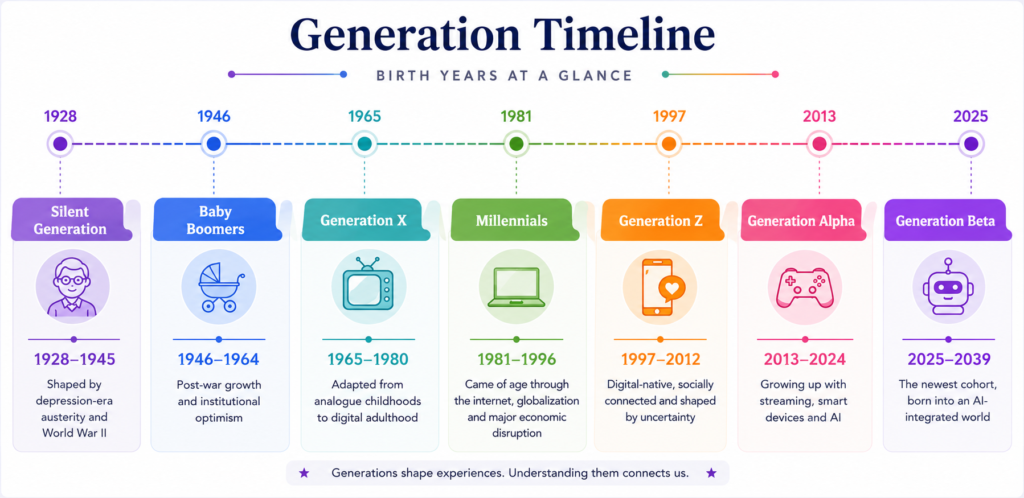
*Ranges vary by source, particularly for Gen Alpha. The 1997–2012 range is commonly used for Gen Z, including in Pew-related generational frameworks.
For the complete age and mindset overview across generations, read: All Generations Explained: Birth Years, Characteristics & Mindset (2026 Guide).
What Shaped Gen Z?
Gen Z did not grow up around one defining event. They grew up amid several overlapping changes, each affecting people differently depending on country, income, family background, education, location, and access to technology.
A Gen Z student with fast internet and access to devices may experience digital life very differently from someone with limited connectivity, heavy family responsibilities, conflict-related disruption, or fewer educational opportunities. Still, the following forces form part of the wider environment around Gen Z.
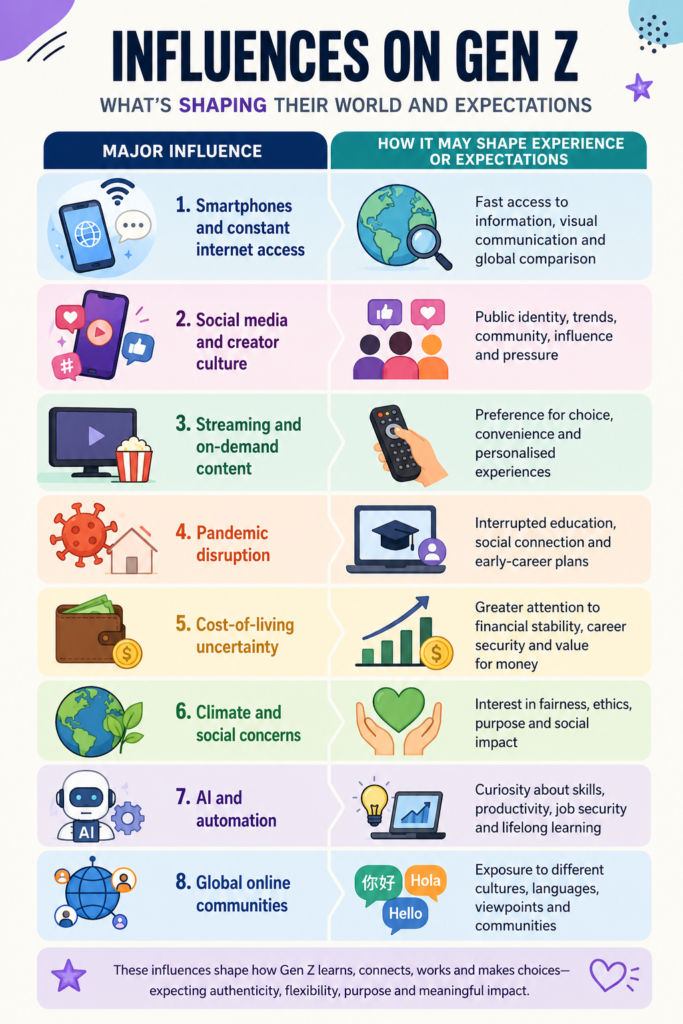
This does not mean every Gen Z person thinks the same way. It means many have grown up in a world where information is immediate, opinions are visible, and change is constant.
The Main Gen Z Characteristics—Without Stereotypes
Many conversations about Gen Z become unhelpful because they turn broad trends into fixed labels. The table below offers a more balanced way to understand common Gen Z characteristics.
| Common Gen Z characteristic | How it can appear in real life | What it does not automatically mean |
|---|---|---|
| Digital fluency | Quick use of apps, AI, search, video and collaboration tools | They are experts in every technology |
| Preference for authenticity | Questions about vague policies, unrealistic promises and performative branding | They are disrespectful of authority |
| Desire for feedback | Requests for clarity, coaching and regular progress updates | They need constant praise |
| Mental-health awareness | More open language about stress, burnout, boundaries and support | They are weak or unable to handle challenge |
| Value-driven choices | Questions about fairness, inclusion, purpose and impact | They reject ambition, money or achievement |
| Preference for flexibility | Interest in control over time, work style and learning options | They avoid accountability |
| Independent learning | Tutorials, short courses, online communities and AI learning tools | They reject teachers, mentors or formal education |
| Entrepreneurial curiosity | Side projects, portfolio work, creator projects and freelancing | Everyone wants to become an influencer |
Important Reminder: Patterns Are Not Personality Types
A person’s life stage, local culture, career, family expectations, income, personality, disability, access to education, and personal history may matter more than their birth year.
A Gen Z engineer in one city may have more in common with a Millennial engineer than with a Gen Z creator in another country. Similarly, a Gen Z student may prefer structure and stability, while another may thrive with flexibility and experimentation.
The most useful question is not, “What are all Gen Z people like?” It is, “What environment shaped this person, and what helps them do their best?”
Why Does Gen Z Seem So Outspoken?
Gen Z may appear outspoken because they grew up with greater access to information, more visible public debate, and more opportunities to see people question institutions, policies, brands, and cultural norms online.
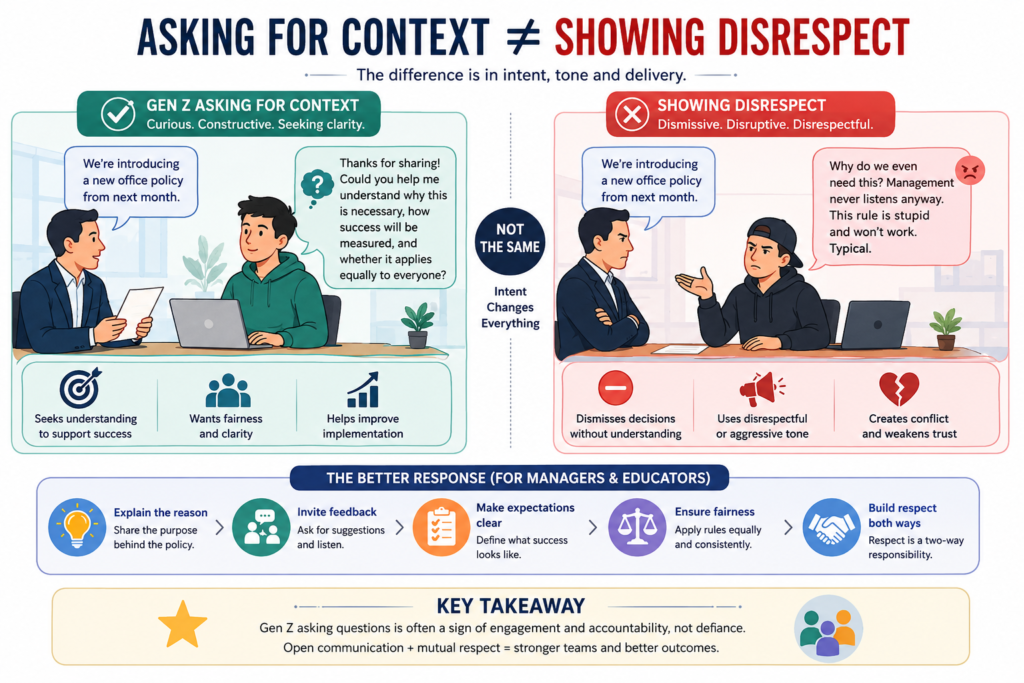
Many have also been encouraged to ask questions, advocate for needs, talk about wellbeing, and seek clarity. Therefore, when a Gen Z employee asks, “Why is this policy different for different teams?” they may be seeking transparency—not trying to create conflict.
“Questions are not always challenges to authority. Often, they are requests for context.”
A practical example
A manager introduces a new office policy. A Gen Z employee asks why it is necessary, how success will be measured, and whether the rule applies equally to everyone.
One person may hear defiance. Another may hear a reasonable request for explanation.
The better response is to explain the reason, invite constructive feedback, and make expectations clear. At the same time, Gen Z employees and students still need to communicate respectfully. Being outspoken does not mean every comment is accurate, mature, or well delivered. Respect remains a two-way responsibility.
Why Does Gen Z Often Seem Smart, Fast and Highly Informed?
Gen Z is not inherently smarter than older generations. Every generation develops skills shaped by the tools available during its formative years.
Gen Z, however, has immediate access to tutorials, online courses, review videos, communities, search engines, visual explanations, collaboration tools, and AI assistants. This can make them appear fast-learning, highly informed, and comfortable navigating unfamiliar platforms.
They may be particularly skilled at:
- Finding information quickly
- Comparing products, courses, jobs, or opinions
- Learning visually through short videos and demonstrations
- Switching between communication formats
- Using digital tools for research, creativity and productivity
- Building knowledge through communities rather than only formal institutions
However, fast access to information is not the same as deep knowledge, critical thinking, judgment, or wisdom. Information overload, misinformation, social comparison, and short attention cycles can create real challenges.
What “smart” may mean for Gen Z
- Fast digital navigation
- Quick pattern recognition
- Visual communication
- Self-directed learning
- Comfort with new tools
What still requires practice
- Deep focus
- Source verification
- Patience with complex tasks
- Long-term planning
- Listening to experience different from their own
Parents and educators can help by teaching young people to verify sources, tolerate complexity, focus deeply, and use AI responsibly—not just quickly.
Gen Z Mindset and Thought Process
The Gen Z mindset is often shaped by choice, uncertainty, and speed.
When information, courses, job listings, reviews, creators, and opinions are always available, young people may become used to comparing options quickly. They may want to know the purpose of a task before committing time and effort. They may also prefer visible progress, practical outcomes, and frequent feedback.
This does not mean they lack patience. It can mean they have learned to ask, “Is this worth my time?” in a world with endless demands on their attention.
Many Gen Z people also see careers less as one straight ladder and more as a set of skills, experiences, projects, and opportunities. They may explore lateral moves, side projects, portfolio careers, freelancing, or further study rather than measuring success only through titles.
Deloitte’s 2026 Global Gen Z and Millennial Survey, based on 22,595 respondents across 44 countries, reported that 96% of Gen Z respondents considered a sense of purpose important to job satisfaction and wellbeing. The same survey found that 74% of Gen Z respondents used AI to some extent in day-to-day work. These findings reflect surveyed respondents, not every young person worldwide; nevertheless, they show why many employers are focusing more on purpose, skills, responsible AI use, and sustainable career development.deloitte+1
Gen Z may not be asking for less effort. They may be asking for clearer purpose, fairer systems, and more sustainable ways to grow.
What Does Gen Z Expect at Home, in Education and at Work?
Gen Z expectations vary by person and circumstance. Still, many young people respond well to clarity, respect, fairness, skill-building, and a sense that their effort has purpose.
| Area | Common expectations | What helps | What usually creates friction |
|---|---|---|---|
| Home and family | Respect, emotional safety, privacy, listening and honest conversation | Curiosity, calm follow-up, boundaries and shared time | Constant comparison, public embarrassment, dismissing feelings |
| School and university | Relevance, interaction, clear instructions, timely feedback and useful skills | Real-world examples, transparent rubrics, participation and encouragement | Unclear grading, one-way lectures and unexplained rules |
| Workplace | Fair pay, growth, mentoring, flexibility where possible, purpose and respect | Specific feedback, defined outcomes, trust and development opportunities | Micromanagement, vague expectations, poor communication and unfairness |
| Digital life | Autonomy, privacy, connection and room to experiment | Digital literacy, reasonable boundaries and open dialogue | Surveillance-only approaches, shame and panic-driven rules |
At Home
Gen Z children and young adults often want emotional safety: the ability to disagree, ask questions, share a problem, and return to a conversation after conflict. This does not mean parents should remove boundaries. It means explaining the “why” behind rules and being willing to listen.
In Education
Gen Z learners often engage more when they can see relevance. A maths concept connected to budgeting, a science lesson linked to climate or health, or a writing task tied to real communication can feel more meaningful than isolated memorisation.
At Work
Many Gen Z professionals want pay and stability, but also learning, mentoring, fairness, and a healthy path to advancement. Deloitte’s 2026 survey found that 44% of Gen Z respondents preferred steady career progression, while 25% preferred fast-paced advancement. The survey also noted that 21% would consider lateral moves or steps back to find the right long-term role. That is not a lack of ambition; it may reflect a different view of how careers develop.
Deloitte Survey findings: https://www.deloitte.com/mt/en/about/press-room/deloitte-2026-gen-z-and-millennial-survey.html
Is Today’s Generation Gap Really New?
No. The generation gap is not new.
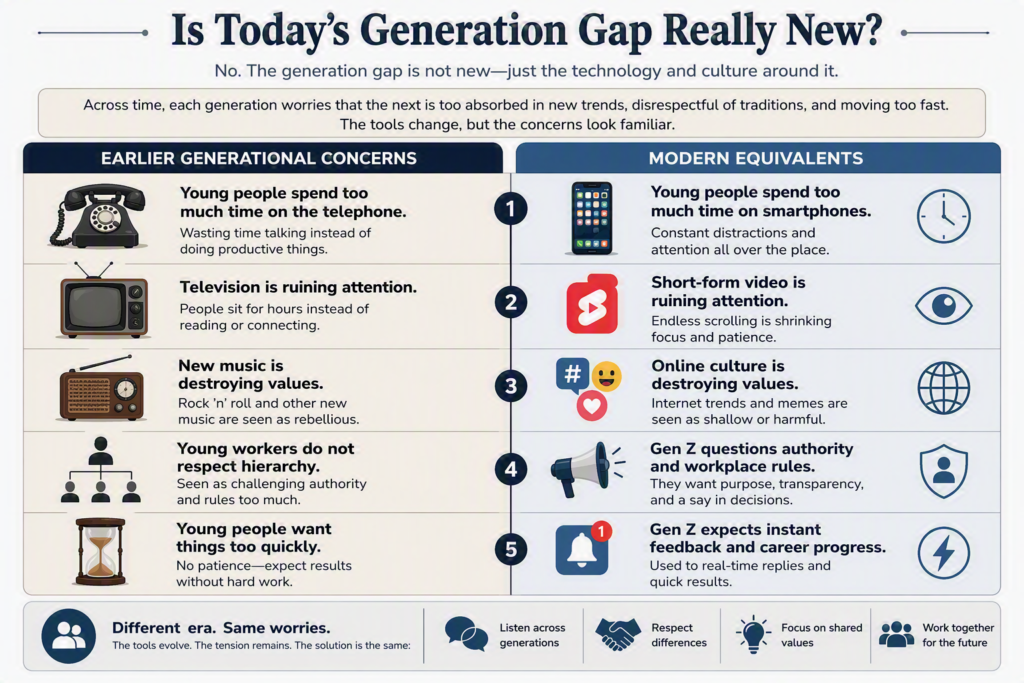
Older generations have often worried that younger people are too informal, too attached to new media, too impatient, too unwilling to follow tradition, or too eager to challenge authority. Similar concerns appeared around radio, television, rock music, personal computers, the internet, mobile phones, and social media.
What is different now is speed. Trends, news, conflict, misinformation, culture, and career changes spread globally in minutes. AI is changing education and work while people are still learning how to use it responsibly. That makes the gap feel sharper and more public.
| Earlier generational concern | Modern equivalent |
|---|---|
| “Young people spend too much time on the telephone.” | “Young people spend too much time on smartphones.” |
| “Television is ruining attention.” | “Short-form video is ruining attention.” |
| “New music is destroying values.” | “Online culture is destroying values.” |
| “Young workers do not respect hierarchy.” | “Gen Z questions authority and workplace rules.” |
| “Young people want things too quickly.” | “Gen Z expects instant feedback and career progress.” |
Some concerns may contain a useful warning. Others are recurring nostalgia. The strongest response is to examine evidence, listen across generations, and avoid assuming the past was perfect.
For perspective on broad generational differences, consider [External Link: Reputable historical or social-science source on generational differences].
How to Communicate and Work Well With Gen Z
For Parents and Families
- Ask before advising. Start with, “Do you want me to listen, help you plan, or share an opinion?”
- Listen for the feeling beneath the words. A complaint about a teacher, job, friend, or trend may actually be about stress, disappointment, or feeling unseen.
- Explain family rules. “Because I said so” may end the conversation, but explaining safety or values can build cooperation.
- Avoid comparisons. Siblings, cousins, classmates, and friends have different paths.
- Respect privacy while remaining available. Space is healthy; emotional disappearance is not.
- Build small, regular conversations. Shared meals, walks, gaming, sport, or a car ride can work better than a formal lecture.
- Support independence with accountability. Give room to decide, while discussing consequences and plans.
Explore practical wellbeing and connection signs in : Gen Z Happiness: 7 Signs Your Child Is Thriving (Not Just Surviving).
For Teachers and Educators
- Explain relevance and real-world value.
- Use interaction, discussion, examples, and opportunities to apply learning.
- State expectations and grading criteria clearly.
- Give timely, specific feedback.
- Teach source checking and deep focus alongside digital skills.
- Treat respectful questions as learning opportunities.
- Balance flexibility with clear academic standards.
A Gen Z student does not need education to be entertaining every second. They do need it to feel understandable, relevant, and worth their effort.
For Managers, HR Teams and Employers
- Be transparent about goals, roles, responsibilities, pay ranges where possible, and development paths.
- Explain why the work matters.
- Give specific feedback and recognition.
- Offer mentoring and skill development.
- Provide flexibility where the role allows, while keeping outcomes and accountability clear.
- Avoid micromanagement.
- Build psychologically safe, respectful teams.
- Address actual behaviour and performance—do not confuse an informal communication style with a lack of professionalism.
Deloitte’s 2026 survey found that 96% of Gen Z respondents viewed purpose as important to job satisfaction and wellbeing, while 74% reported some AI use at work. Managers should set responsible AI expectations and provide training instead of assuming younger employees already know how to use every tool safely or effectively.
Common Myths About Gen Z—And the More Useful Reality
| Myth | More useful reality |
|---|---|
| “Gen Z is lazy.” | Many reject burnout as the default price of success while still valuing skills, stability and meaningful work. |
| “Gen Z does not want to work.” | Many want fair pay, development, flexibility, purpose and sustainable growth. |
| “Gen Z cannot accept feedback.” | Many want frequent, specific, fair feedback; vague criticism is difficult for most people. |
| “Gen Z is always on the phone and cannot communicate.” | They often communicate effectively online but may still need support with formal, in-person and deep communication. |
| “Gen Z expects instant success.” | Many prefer steady progress, learning and sustainable growth over rapid promotions. |
| “Gen Z is too sensitive.” | They may use more open language for stress, boundaries and wellbeing; resilience and support can coexist. |
| “Every Gen Z person wants to become an influencer.” | Gen Z careers are diverse across every field, industry and community. |
The goal is not to replace one stereotype with a positive stereotype. It is to make room for complexity.
Understanding Gen Z Language and Digital Communication
Slang, emojis, memes, short videos, voice notes, reaction buttons, and inside jokes are part of modern communication. Informal digital language does not automatically mean weak communication skills.
However, young people benefit from learning to adapt their tone to different settings. The way they speak with friends may not suit a university application, customer email, interview, classroom discussion, or workplace meeting.
This is called code-switching: knowing when to be casual and when to be formal. It is a valuable life skill for everyone.
Start with the basics in : Gen Z Slang Cheat Sheet: 10 Common Slang Words You Need to Know. Then explore newer trends through: 15 Fresh Gen Z Slang Terms to Know in 2026 and see how casual language works in everyday conversation in: 12 Gen Z Slang Terms You’ll Actually Want to Use in Real Conversations.
Frequently Asked Questions About Gen Z
What years are Gen Z?
Gen Z is commonly defined as people born from around 1997 to 2012. Exact birth-year boundaries can vary by source.
How old is Gen Z in 2026?
Using the 1997–2012 range, Gen Z is approximately 14 to 29 years old in 2026.
What are the main Gen Z characteristics?
Commonly discussed characteristics include digital fluency, preference for authenticity, interest in feedback, mental-health awareness, value-driven decisions, flexibility, independent learning, and curiosity about multiple career paths. These are broad trends, not rules.
Why is Gen Z so outspoken?
Many Gen Z people grew up with easy access to information, visible public debate, and encouragement to ask questions. Directness can be a request for context, fairness, or clarity—not necessarily disrespect.
Why does Gen Z seem smart with technology?
Gen Z has grown up with digital tools, tutorials, social platforms, and AI. This may support quick digital navigation, but deep knowledge, critical thinking, and source verification still require practice.
Is Gen Z different from Millennials?
Yes, but there is overlap. Millennials grew up during the transition into the internet and smartphones, while Gen Z experienced a more always-connected childhood and adolescence.
Does Gen Z want to work?
Many Gen Z people want work that offers fair pay, learning, stability, purpose, respect, and a sustainable lifestyle. Preferences vary by personal circumstances and location.
What does Gen Z expect from employers?
Common expectations include clarity, fairness, feedback, development, mentoring, flexibility where possible, responsible technology use, and respect.
How should parents communicate with Gen Z?
Use curiosity, calm follow-up, clear reasons for rules, regular small conversations, and less comparison. Listen before offering advice.
How can teachers engage Gen Z students?
Show relevance, set clear expectations, use participation and real-world examples, provide timely feedback, and teach critical thinking alongside digital fluency.
Is the generation gap new?
No. Older generations have long worried about the media, culture, and work habits of younger people. What is new is the speed and public visibility of change.
Final Thoughts: Understanding Is Better Than Labelling
So, who is Gen Z?
Gen Z is not one personality type, one political view, one career goal, or one social-media habit. They are a diverse generation shaped by an environment of rapid digital change, global connection, economic uncertainty, AI, social visibility, and changing definitions of success.
Their habits often make more sense when viewed in context. Asking “why?” before assuming “what is wrong?” can transform a difficult conversation at home, in a classroom, or at work.
Every generation has been shaped by its era—and every generation has, at some point, been misunderstood by the people before it. Gen Z is no exception.
Parents, teachers, managers, employers, and Gen Z readers can reduce the gap through curiosity, clarity, mutual respect, boundaries, and honest conversation. The goal is not to agree on everything. It is to understand enough to work, learn, and live well together.
What is one Gen Z characteristic you recognise in yourself, your child, your students, or your colleagues? Share your perspective in the comments.
Share this guide with someone from another generation and start a better conversation.
- Gen Z vs Gen Alpha: 12 Key Differences Explained
- Who Is Gen Z? Characteristics, Mindset, Behaviour & Expectations (2026 Guide)
- 16 Gen Z Slang Words You Haven’t Heard Yet: Meanings, Examples & Context (2026)
- 10 Gen Z Phrases Every Parent Should Know in 2026 (With Examples)
- Gen Z Happiness: 7 Signs Your Child Is Thriving (Not Just Surviving)