Just When You Learn One Word, the Internet Invents Five More
You finally understand what rizz means. Then someone writes “FRFR,” says a celebrity “understood the assignment,” asks for “receipts,” and tells everyone to stop doomscrolling.
At that point, it can feel like the internet is speaking in code.
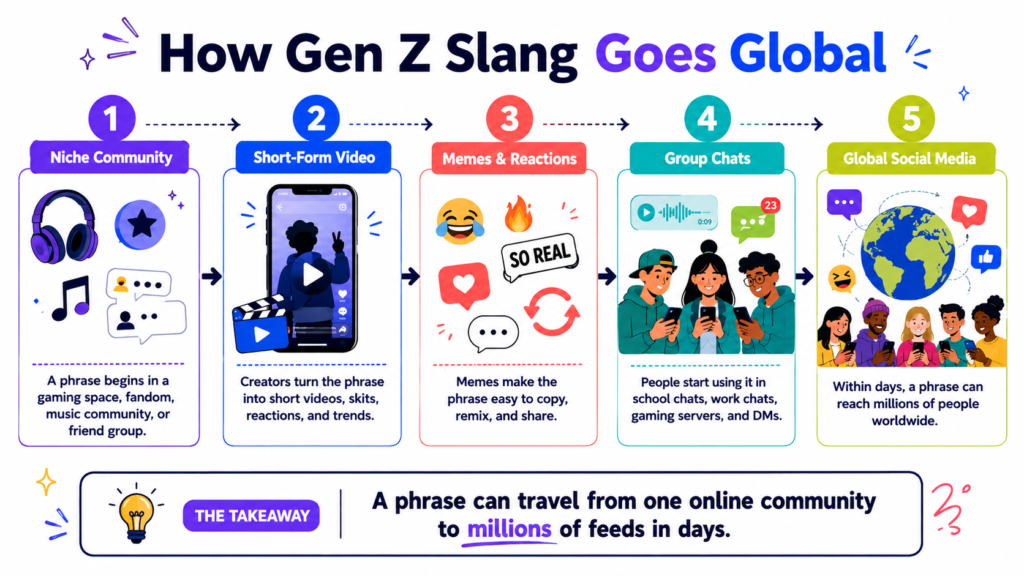
The truth is that new Gen Z slang words appear and spread at internet speed. TikTok, Instagram, YouTube, Discord, gaming spaces, memes, music, group chats, and creator culture can take a phrase from a small community to a worldwide trend within days.
This guide does not expect you to memorise every trend. It helps you understand the words, tone, context, and social meaning behind 16 new Gen Z slang words. Whether you are a student, parent, teacher, manager, friend, or simply someone who wants to understand online conversations better, this is your no-stress translation guide.
“Learning the meaning is useful. Knowing the context is what keeps you from using it wrong.”
Why New Gen Z Slang Words Spread So Quickly
Internet language is fast because the internet is fast.
A phrase may begin in a fandom, gaming community, music scene, meme page, or friend group. Then it appears in short videos, reaction clips, comments, livestreams, and group chats. Soon, people across different countries are using it in completely different situations.
Slang can express admiration, irony, frustration, identity, humour, belonging, and criticism. However, it also changes depending on the speaker and setting. A phrase that sounds funny between close friends may feel rude in a classroom, workplace, public comment section, or family argument.
Not every Gen Z person uses every expression. Language differs by region, culture, online platform, age, friend group, and personal style. Therefore, understanding these terms matters more than forcing them into every conversation.
For the wider context behind generational communication, read: All Generations Explained: Birth Years, Characteristics & Mindset (2026 Guide).
Quick Guide to 16 New Gen Z Slang Words
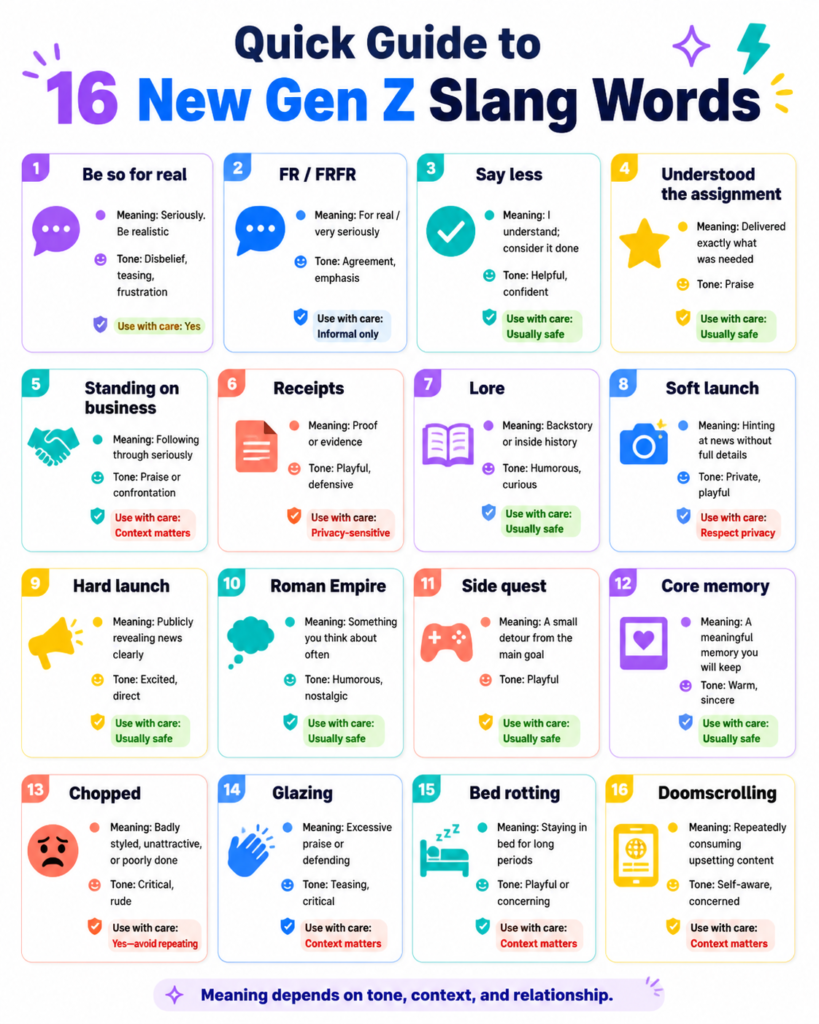
16 New Gen Z Slang Words Explained With Real Examples
1. Be So for Real
What it means: “Be so for real” means “Seriously?” or “You cannot honestly believe that.”
How it is used: People use it when they are surprised, doubtful, annoyed, or playfully challenging someone.
Example: “You think you can finish the group project in ten minutes? Be so for real.”
Tone and context: It can be friendly teasing between friends. However, in an argument, it can sound frustrated or dismissive.
Use with care: Context-dependent. Avoid using it with someone who is sharing a serious concern.
Plain-English translation: “Please be realistic” or “Are you serious right now?”
2. FR / FRFR
What it means: FR means “for real.” FRFR means “for real, for real,” adding stronger emphasis.
How it is used: It appears most often in texts, comments, captions, and group chats to show agreement or sincerity.
Example: “That deadline came too fast, FRFR.”
Tone and context: Usually casual agreement. It often means, “I completely agree.”
Use with care: Fine among friends, but do not write “FRFR” in a professional email, formal school submission, or job application.
Plain-English translation: “Seriously” or “I completely mean it.”
3. Say Less
What it means: “Say less” means “I understand,” “You do not need to explain more,” or “Consider it done.”
How it is used: It often signals willingness to help or quick agreement.
Example: “You need someone to review your slides before the presentation? Say less.”
Tone and context: Supportive, confident, and usually positive.
Use with care: Generally harmless. However, a manager or teacher may prefer clearer confirmation in formal settings.
Plain-English translation: “I understand. I’ll handle it.”
4. Understood the Assignment
What it means: This phrase means someone clearly understood what was expected and delivered it exceptionally well.
How it is used: It is often used to praise fashion, performances, creative work, marketing, speeches, events, and social-media content.
Example: “That campaign video? She understood the assignment.”
Tone and context: Enthusiastic praise. It is a step beyond “good job.”
Use with care: Generally safe in casual settings. In a professional setting, use plain praise instead.
Plain-English translation: “They understood exactly what was needed and did it brilliantly.”
5. Standing on Business
What it means: “Standing on business” means taking responsibilities, values, promises, or stated intentions seriously and following through.
How it is used: It can praise someone for being reliable or serious. It can also sound confrontational when someone is setting a firm boundary.
Example: “He said he would finish the work before Friday, and he did. He is standing on business.”
Tone and context: Confident and approving in one setting; intense or challenging in another.
Use with care: Use carefully at work. The phrase may sound overly casual or aggressive in a formal meeting.
Plain-English translation: “They meant what they said and followed through.”
6. Receipts
What it means: “Receipts” are proof: screenshots, messages, photos, links, or other evidence that supports a claim.
How it is used: It is often used in group chats or online debates when someone wants to prove they warned another person, made a point, or told the truth.
Example: “You said I never reminded you about the meeting? I have the receipts.”
Tone and context: Playful, defensive, or argumentative.
Use with care: Privacy-sensitive. Evidence should never become an excuse to share private chats, embarrass others, leak photos, or violate trust.
Plain-English translation: “I have proof.”
7. Lore
What it means: “Lore” is the backstory behind a person, friendship, event, joke, fandom, or ongoing situation.
How it is used: It comes from storytelling and fandom culture. In daily life, it makes a long explanation sound more dramatic and entertaining.
Example: “You need the full lore before this group-chat argument makes sense.”
Tone and context: Curious, playful, and often humorous.
Use with care: Usually harmless. However, do not pressure someone to share personal history they want to keep private.
Plain-English translation: “You need the full backstory.”
Mini group-chat moment:
“Why does everyone laugh when Sam sends a frog emoji?”
“You missed the 2023 frog incident. The lore is too long.”
8. Soft Launch
What it means: A soft launch is a subtle hint about something new—a relationship, job, project, move, business, or life update—without sharing all the details.
How it is used: People may post a photo of two coffees, a cropped hand, a new city view, or a blurred project logo.
Example: “The photo only showed two coffees and one hand. Definitely a soft launch.”
Tone and context: Playful, private, and slightly mysterious.
Use with care: Privacy-sensitive. A soft launch can be a person’s choice to share only part of their news. Do not pressure them to reveal more.
Plain-English translation: “They are hinting at something new without fully announcing it.”
9. Hard Launch
What it means: A hard launch is the opposite of a soft launch: a clear and public reveal of something previously private or only hinted at.
How it is used: It may involve a full relationship photo, a business announcement, a new job post, a travel reveal, or a launch video.
Example: “After months of hints, they hard launched the new business with a full video.”
Tone and context: Excited, direct, and celebratory.
Use with care: Generally harmless. Still, remember that public announcements can bring attention, comments, and pressure.
Plain-English translation: “They officially announced it publicly.”
10. Roman Empire
What it means: A “Roman Empire” is something a person thinks about surprisingly often.
How it is used: It started as an internet joke about how often some people think about the Roman Empire. Now it can refer to any favourite moment, topic, game, sports result, trip, movie scene, or random memory.
Example: “That final match from 2019 is my Roman Empire.”
Tone and context: Nostalgic, humorous, and personal.
Use with care: Usually safe. It is a fun way to ask people what topic lives in their mind.
Plain-English translation: “This is something I think about all the time.”
11. Side Quest
What it means: A side quest is a small, optional, unexpected, or distracting activity outside your main plan.
How it is used: The term comes from gaming, where players take optional missions. In daily life, it turns ordinary detours into a funny story.
Example: “I went out to buy groceries and came back with a plant. Side quest completed.”
Tone and context: Playful and self-aware.
Use with care: Usually harmless. It can make a boring daily story sound more fun.
Plain-English translation: “I got distracted by an unexpected extra task.”
12. Core Memory
What it means: A core memory is a meaningful moment you believe you will remember for a long time.
How it is used: People use it for emotional, joyful, nostalgic, or life-changing experiences.
Example: “Watching the sunrise after graduation felt like a core memory.”
Tone and context: Warm, sincere, and sometimes sentimental.
Use with care: Usually safe. However, remember that meaningful moments are personal—do not mock someone’s memory because it seems small to you.
Plain-English translation: “This feels like a memory I will carry for years.”
13. Chopped
What it means: “Chopped” often means unattractive, badly styled, poorly done, or disappointing.
How it is used: It may refer to a haircut, outfit, photo, design, performance, or object.
Example: “That haircut is chopped.”
Tone and context: Usually critical and often harsh.
Use with care: Yes. It can be hurtful, especially when aimed at someone’s appearance. It is best understood rather than repeated.
Plain-English translation: “That looks badly done” or “I do not think that looks good.”
Respectful communication matters online and offline. There is a difference between offering kind feedback and using humour to embarrass someone.
14. Glazing
What it means: “Glazing” means praising, defending, admiring, or flattering someone excessively—so much that it seems embarrassing or insincere.
How it is used: It often appears when someone will not stop defending a celebrity, athlete, creator, friend, or brand.
Example: “You have defended that celebrity for ten minutes. The glazing is unreal.”
Tone and context: Usually teasing or critical.
Use with care: Context-dependent. Genuine appreciation is not automatically glazing. The phrase is often used to shut down enthusiasm, so use it carefully.
Plain-English translation: “You are praising them far too much.”
15. Bed Rotting
What it means: “Bed rotting” means spending a long time in bed, often scrolling, watching shows, resting, or avoiding responsibilities.
How it is used: People frequently use it jokingly to describe an unproductive weekend or recovery day.
Example: “My Sunday plan is bed rotting and watching three seasons of that show.”
Tone and context: Often playful and self-aware.
Use with care: Context-dependent. One lazy day is normal. However, ongoing withdrawal, persistent low mood, or major changes in daily functioning deserve supportive attention.
Plain-English translation: “I plan to stay in bed for a long time and do very little.”
This phrase alone does not reveal someone’s mental health. Look at broader patterns, not one caption or joke.
16. Doomscrolling
What it means: Doomscrolling means repeatedly consuming upsetting, negative, or anxiety-inducing news and social-media content for a long period.
How it is used: Someone may begin by checking one headline, then keep scrolling through difficult news, arguments, disasters, or distressing posts.
Example: “I meant to check one headline, then spent an hour doomscrolling.”
Tone and context: Often self-aware, tired, or concerned.
Use with care: Context-dependent. It describes a common digital habit, not a diagnosis.
Plain-English translation: “I kept scrolling through upsetting content even though it was making me feel worse.”
A few gentle digital-wellbeing strategies can help: set a news-checking time, turn off non-essential alerts, take device-free breaks, and rely on trusted sources rather than endless feeds.
Slang That Is Fun, Slang That Needs Context
| Usually casual and positive | Context-dependent | Best understood, not repeated |
|---|---|---|
| Say less | Be so for real | Chopped |
| Understood the assignment | FR / FRFR | |
| Lore | Standing on business | |
| Side quest | Receipts | |
| Core memory | Soft launch | |
| Roman Empire | Hard launch | |
| Glazing | ||
| Bed rotting | ||
| Doomscrolling |
Understanding slang does not mean every phrase belongs in school, work, public comments, or conversations with people you do not know. Good communication always considers the setting.
How Parents, Teachers and Adults Can Respond Naturally
1. Ask With Curiosity, Not Judgment
Try:
“I have heard that phrase before—what does it mean in this situation?”
That question shows interest without making someone feel examined.
2. Listen for the Feeling Behind the Phrase
A joke about doomscrolling may point to stress. A “core memory” comment may reveal excitement or belonging. Meanwhile, “I’m bed rotting” may simply describe a lazy weekend.
Focus on the feeling and the wider context.
3. Do Not Correct Every Informal Word
Language changes naturally. Constant correction can make people stop sharing.
You do not need to use slang yourself. You only need to understand enough to keep the conversation open.
4. Use Plain, Natural Language
You can say:
“That sounds exciting.”
“Tell me the backstory.”
“I understand why you are disappointed.”
“Would you like help?”
These responses work across generations.
5. Respect Privacy
“Receipts,” group chats, and soft launches do not give anyone permission to demand private messages, screenshots, passwords, or access to someone else’s online life.
Privacy and trust still matter.
6. Keep Serious Issues Separate From Slang
One slang word is not a diagnosis. Instead, pay attention to repeated changes in wellbeing, behaviour, safety, sleep, work or school functioning, and connection with others.
For a wider guide to supportive parent-child connection, read: Gen Z Happiness: 7 Signs Your Child Is Thriving (Not Just Surviving).
Frequently Asked Questions
What are the newest Gen Z slang words in 2026?
Common terms seen in online conversations include “be so for real,” “FRFR,” “say less,” “understood the assignment,” “standing on business,” “lore,” “side quest,” “core memory,” “bed rotting,” and “doomscrolling.” Popularity varies by platform and community.
What does FRFR mean in texting?
FRFR means “for real, for real.” It adds strong emphasis and usually means, “I completely agree” or “I am completely serious.”
What does “be so for real” mean?
It means “seriously?” or “please be realistic.” It can be playful between friends or annoyed in an argument.
What does “standing on business” mean?
It means taking your responsibilities, promises, actions, or values seriously and following through.
What are “receipts” on social media?
Receipts are proof, such as screenshots, messages, images, links, or other evidence supporting a claim. Sharing them should never override privacy or respect.
What is the difference between a soft launch and a hard launch?
A soft launch hints at news without full details. A hard launch is a clear, public announcement.
What does “side quest” mean in Gen Z slang?
A side quest is an unexpected, optional, or distracting activity outside your main task or plan.
Is “bed rotting” a serious concern?
Not automatically. People often use it jokingly to describe resting in bed. If it appears alongside persistent withdrawal, low mood, or difficulty functioning, a supportive check-in may help.
What does doomscrolling mean?
Doomscrolling is repeatedly consuming upsetting news or negative social-media content for long periods, often beyond the point where it feels helpful.
Is it okay to use Gen Z slang at work or school?
Use caution. Slang may be acceptable in informal conversations with people who understand it. However, clear professional language is usually safer in formal emails, presentations, applications, and meetings.
Final Thoughts: Understand the Context Before You Use the Word
Learning new Gen Z slang words can make online culture, group chats, memes, and everyday conversations easier to understand. However, the point is not to memorise every phrase or force yourself to use language that does not feel natural.
Slang changes quickly. Respect and curiosity do not.
A phrase such as “say less” may show helpfulness. “Core memory” may show genuine emotion. “Doomscrolling” may describe a habit someone wants to change. Meanwhile, terms like “chopped” can be hurtful when aimed at another person.
Learn the meaning. Consider the setting. Notice the tone. Then respond in your own voice.
Gen Z slang can be entertaining, expressive, and useful for understanding modern digital culture—but context is always the real key.
Which of these 16 new Gen Z slang words have you seen most often online? Share your answer in the comments. Share this guide with a friend, parent, teacher, colleague, or relative who keeps seeing these phrases online.